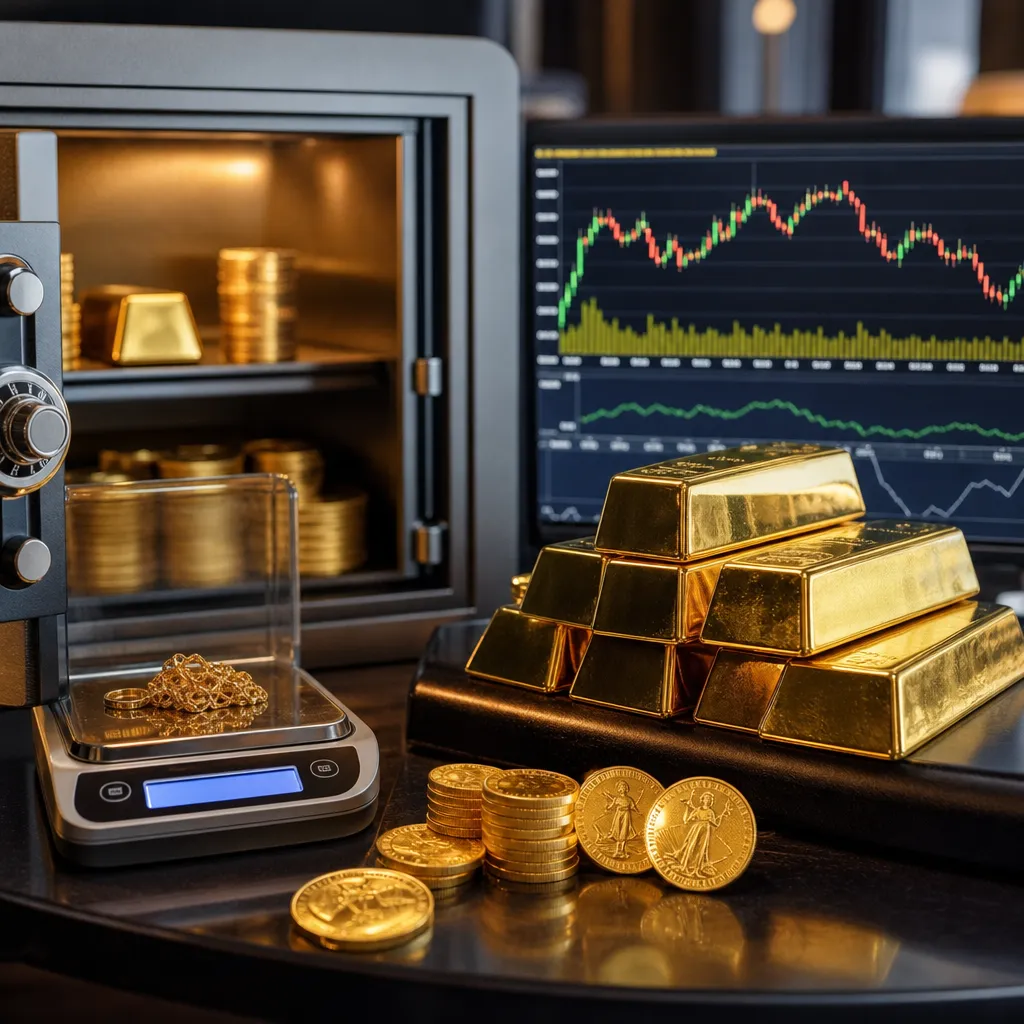
Gold price and mining supply are linked, but not in the simple way many people assume. A higher gold price does not immediately produce much more gold, and weak prices do not instantly remove supply from the market. The reason is that mining is capital-intensive, slow to respond, and heavily shaped by geology, costs, financing, permitting, and political risk. For anyone trying to understand gold, this matters because mine supply influences long-term market balance, investor sentiment, and the economics of gold mining companies.
The key point is straightforward: mining supply affects gold over the medium and long term more than from one week to the next. In the short run, macro forces such as real yields, the US dollar, central bank behavior, ETF flows, and risk sentiment usually dominate the gold price. Over longer periods, however, the ability of miners to discover, build, operate, and sustain production becomes an important part of the market story.
What “gold price and mining supply” really means
This topic refers to the relationship between the market price of gold and the amount of gold produced by mines. It includes both directions of influence:
- Gold price to mine supply: when prices rise, mining projects may become more profitable, encouraging investment, expansions, and mine development.
- Mine supply to gold price: if global mine supply grows meaningfully relative to demand, it can reduce some upward pressure on prices over time.
Unlike many industrial commodities, gold behaves differently because most of the gold ever mined still exists in bars, coins, jewelry, official reserves, and other forms. That means the gold market is shaped not just by new mine output, but by the much larger above-ground stock and by owners’ willingness to hold or sell.
Why mining supply does not control the gold price in the short term
Investors often assume that more mining should quickly lower the gold price. In practice, short-term pricing is usually driven more by financial-market variables than by annual mine production changes. Gold trades globally, continuously, and largely as a monetary and investment asset rather than a purely consumable raw material.
The table below shows why the relationship is usually slower and less direct than many expect.
| Factor | Typical influence on gold price | Why mine supply is not the sole driver |
|---|---|---|
| Real interest rates | Often very important | Higher real yields can raise the opportunity cost of holding a non-yielding asset such as gold. |
| US dollar strength | Often important | Gold is commonly priced in dollars, so currency moves can affect global pricing quickly. |
| Geopolitical stress | Can be strongly supportive | Safe-haven demand can push gold higher even if mine output is unchanged. |
| ETF and investment flows | Often important | Large buying or selling by investors can move the market faster than mine supply can respond. |
| Central bank demand | Potentially supportive | Official-sector buying can absorb supply without any immediate change in mine production. |
| Mine production | More gradual influence | Production changes usually emerge slowly and rarely explain short-term price swings by themselves. |
The main takeaway is that mine supply matters, but it usually operates in a slower, structural way. Gold can rally sharply even during periods of solid mine output, and it can weaken even when production growth is limited.
How higher gold prices affect mining supply
When the gold price rises and stays elevated, producers and developers generally gain more flexibility. Marginal ore becomes more economic, expansion projects can improve in attractiveness, and financing conditions for exploration and development may improve. But the response is delayed.
A gold mine cannot be turned on like a factory switch. The process often involves exploration drilling, resource definition, feasibility studies, environmental review, permitting, financing, infrastructure construction, labor recruitment, equipment procurement, and ongoing operational execution. Even after a major price rise, meaningful new supply may take years to reach the market.
Channels through which price can increase supply
- Cut-off grades may fall: miners may process lower-grade ore if the revenue per ounce improves.
- Mine life may be extended: deposits that were previously uneconomic may remain in production longer.
- Brownfield expansions may advance: existing mines may add capacity more easily than entirely new projects.
- Exploration spending may rise: companies may increase drilling budgets when expected returns improve.
- Development financing may become easier: lenders and equity investors are often more receptive in strong gold-price environments.
Still, not every higher-price period produces a proportional supply boom. Cost inflation, skilled labor shortages, energy costs, permitting delays, local opposition, taxes, and political risk can offset much of the benefit from a stronger gold price.
What limits the mining supply response
The most important constraint is time. Gold mining is one of the slower forms of commodity supply response because ore bodies are fixed in location and quality, and mine development is technically complex. Prices can rise quickly, but sustainable production growth usually comes much later.
There are also structural limits to how much production can expand. Many mature gold districts are already well explored. New discoveries are harder to find, often lower grade, deeper, more remote, or located in jurisdictions with higher operating or political risks.
The following table summarizes the main constraints.
| Constraint | How it affects supply | Practical significance |
|---|---|---|
| Permitting and regulation | Delays new mines and expansions | Even attractive projects may take years before first production. |
| Ore grade quality | Lower grades can limit profitability | High gold prices help, but low-grade ore remains operationally challenging. |
| Capital intensity | Raises financing needs | Large projects may still struggle if capital markets are tight. |
| Energy, labor, and consumable costs | Can erode margins | A rising gold price does not guarantee rising free cash flow. |
| Political and jurisdictional risk | Can disrupt operations or investment | Tax changes, unrest, or policy shifts can restrict supply growth. |
| Technical and geological complexity | Increases execution risk | Production plans often face setbacks, lower recoveries, or operational surprises. |
This is why strong gold prices may improve mining economics without producing an immediate flood of new metal.
How mining supply can influence the gold price
Mine supply does matter, especially when looked at together with recycled gold and broader demand trends. If mine production grows steadily while investment demand is soft and central bank buying slows, that can contribute to a less supportive gold environment. Conversely, if mine supply stagnates while demand strengthens, the market may tighten.
But the mechanism is different from oil or natural gas. Gold is not mostly consumed and destroyed. Instead, newly mined supply adds to a very large above-ground inventory. Because of that, annual mine output is important, but it is only one part of the total available stock.
Why above-ground stocks matter
Gold in jewelry, bullion, ETFs, and reserves can re-enter the market through selling, lending, refining, or recycling. This means the relevant question is not only “how much gold are miners producing?” but also “how much existing gold are owners willing to part with, and at what price?”
That is one reason the gold price can rise despite healthy mine production: holders may simply prefer to keep their gold if they are worried about inflation, financial instability, or currency weakness.
Mine supply versus recycled supply
When people discuss gold supply, they often focus too much on mining and ignore recycling. Recycled gold can respond more quickly to price changes than mine output. If the gold price rises sharply, scrap sales from jewelry holders and other market participants may increase, adding supply without any new mine being built.
This interaction is useful to watch because recycled supply can partly cushion price spikes, especially when prices rise fast enough to encourage profit-taking or liquidation.
| Supply source | Speed of response to higher prices | Main characteristics |
|---|---|---|
| Mine supply | Slow | Requires exploration, development, permits, capital, and operating execution. |
| Recycled supply | Faster | Can increase when households, jewelers, or investors sell existing gold into the market. |
| Official sales or market mobilization | Variable and policy-sensitive | Can matter in specific periods, but depends on reserve policy, lending conditions, and institutional behavior. |
The practical implication is that mining supply is not the only form of supply that matters. In some environments, recycling may be more responsive than primary mine output.
Why gold mining stocks can behave differently from the gold price
Investors often use mining shares as a way to gain exposure to gold. That can work, but mining stocks are not the same as bullion. A miner’s performance depends not only on the gold price, but also on costs, reserve quality, debt levels, hedging, country risk, management, and operational execution.
If the gold price rises, miners may benefit through wider margins. But if diesel, wages, steel, explosives, and sustaining capital costs also rise, the company’s benefit may be smaller than expected. In some cases, the gold price can be strong while miners underperform because equity investors are worried about cost inflation or project risk.
- Bullion exposure is cleaner and more direct.
- Mining stocks offer operating leverage, but also company-specific risk.
- Royalty and streaming companies often provide gold-linked exposure with different cost and operating-risk profiles.
What investors should watch when analyzing gold price and mining supply
If you want to understand whether mine supply is becoming more relevant to the market, focus on trend indicators rather than one-off headlines. The key is to assess whether higher prices are translating into sustainable production growth, not just temporary optimism.
Important signals to monitor
- Producer guidance: are major miners growing output or mostly replacing depletion?
- Reserve replacement: are companies finding enough new ounces to sustain future production?
- Project pipeline quality: are new mines low cost, high grade, and realistically financeable?
- Cost pressures: are all-in sustaining costs rising fast enough to offset the gold-price tailwind?
- Permitting environment: are new projects moving through approvals or getting delayed?
- Recycling trends: are higher prices increasing secondary supply?
- Demand backdrop: are ETF flows, central bank buying, and physical investment demand absorbing available supply?
In other words, supply analysis only becomes useful when paired with demand and macro analysis. Looking at mine output alone rarely gives a complete picture of where gold may trade.
Key limitations and common misconceptions
A frequent misconception is that gold prices should fall whenever miners produce more. That may happen if supply growth arrives at the same time as weak demand and restrictive monetary conditions, but it is not automatic. Gold is a financial asset with a large stock already in existence, and macro variables can dominate for long periods.
Another misconception is that higher prices always help all miners equally. They do not. Mines with short reserve life, weak jurisdictions, high strip ratios, balance-sheet stress, or rising capital needs may struggle even in a favorable gold market.
Finally, it is important not to confuse revenue with profitability. A stronger gold price increases top-line potential, but margins depend on costs, recoveries, taxes, royalties, sustaining capital, and execution.
FAQ
Does more gold mining always lower the gold price?
No. Higher mine output can add supply over time, but gold prices are often driven more immediately by real yields, the US dollar, investor flows, central bank demand, and risk sentiment. Because gold has a very large above-ground stock, annual mine production is only part of the picture.
Why doesn’t a higher gold price lead to immediate supply growth?
Because mining projects take time. Exploration, permitting, financing, construction, and ramp-up can take years. Existing mines can sometimes respond at the margin, but large increases in global supply are usually slow.
Is mine supply or investment demand more important for gold?
In the short run, investment demand is often more important for price direction. In the long run, mine supply matters because it affects market balance and the economics of producers. The strongest analysis considers both.
How does recycled gold affect the market?
Recycled gold can respond more quickly to price moves than mine production. When prices rise sharply, scrap selling may increase, which can add supply and partly moderate the market.
Do gold mining stocks simply track the gold price?
No. Mining shares are influenced by the gold price, but also by energy costs, labor costs, geography, debt, reserve quality, management decisions, hedging, and equity-market sentiment. They can outperform or underperform bullion.
Can weak mine supply be bullish for gold?
Potentially, yes, especially if demand is firm. If production growth is limited by geology, permitting, cost inflation, or political risk while investment or central bank demand remains strong, that can be supportive for prices.
What is the biggest mistake when analyzing gold supply?
Looking only at newly mined ounces. A complete view must also include recycled supply, above-ground stocks, central bank behavior, ETF flows, and the macro environment.
Sources
- World Gold Council – gold market supply and demand research
- U.S. Geological Survey – gold mining and mineral commodity information
- LBMA – gold market and pricing information