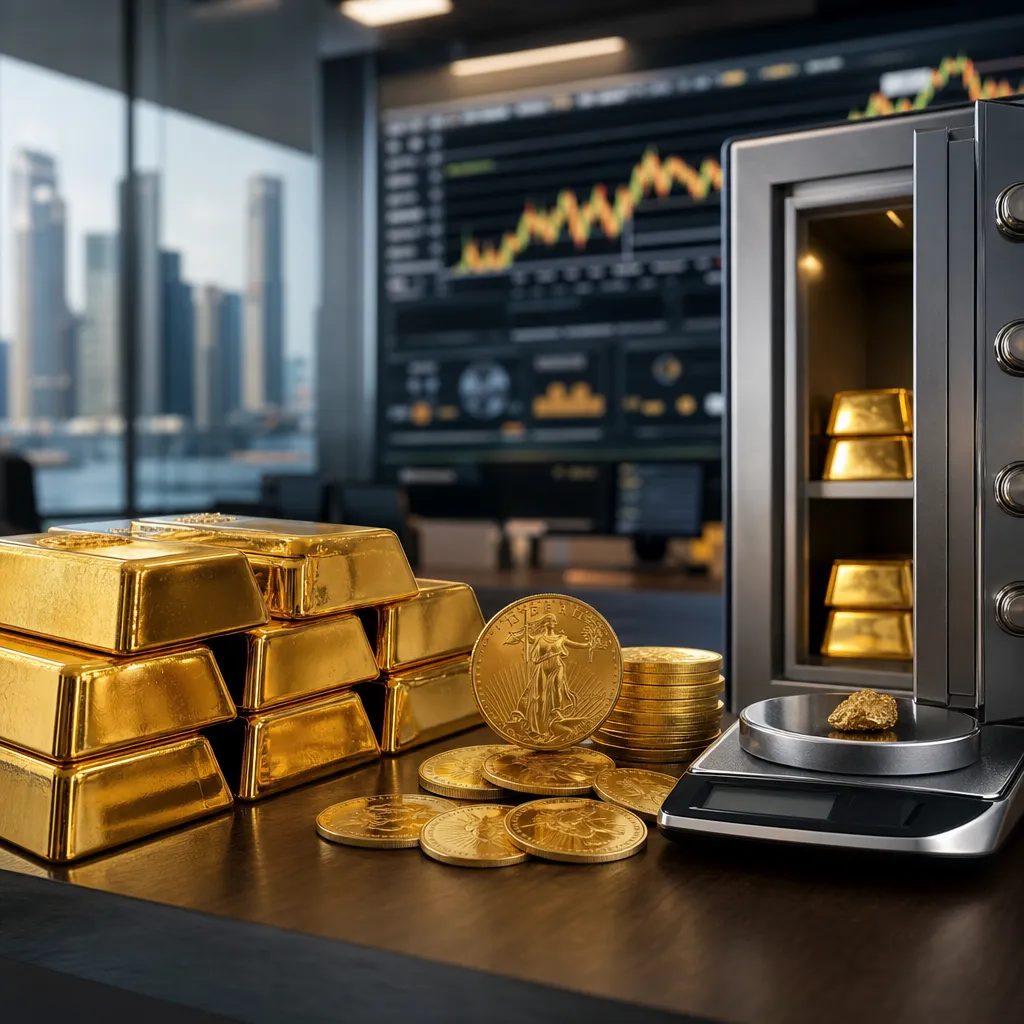
Gold futures and spot gold are closely related, but they are not the same market. Spot gold refers to the current wholesale price for gold available for near-immediate delivery, while gold futures are standardized exchange-traded contracts to buy or sell gold at a later date. For investors and traders, the distinction matters because pricing, leverage, settlement, risk, and market use are very different.
If you are comparing gold futures vs spot gold, the key point is simple: spot gold is the reference cash market price, while futures are derivative contracts whose value is linked to gold but shaped by time, financing, storage, and market positioning. Understanding that difference helps explain why futures can trade above or below spot, why traders use them for hedging and speculation, and why physical bullion buyers often pay something different again.
What spot gold actually means
Spot gold is the benchmark market price for gold for settlement on standard near-term terms, typically associated with large wholesale transactions rather than small retail purchases. It is usually quoted per troy ounce in U.S. dollars, although it is widely referenced in other currencies as well.
Importantly, spot gold does not mean the price you pay for a coin or bar from a dealer. Retail products include fabrication costs, distribution costs, dealer margin, and often a bid-ask spread. So when people say “the gold price,” they are often referring to spot, not the final retail price of physical bullion.
What gold futures are
Gold futures are standardized contracts traded on futures exchanges such as COMEX, part of CME Group. A futures contract lets market participants agree today on a price for gold to be delivered, or cash-settled depending on contract terms and how the position is handled, at a specified future month.
Most futures traders do not intend to take delivery of metal. They use futures to gain price exposure, hedge physical positions, or trade short-term moves with margin. That makes futures a highly liquid price-discovery venue, especially for institutional and active market participants.
The practical differences are easier to see side by side:
| Feature | Spot Gold | Gold Futures |
|---|---|---|
| What it is | Current wholesale reference price for gold | Standardized exchange-traded contract linked to future gold delivery or settlement |
| Typical users | Bullion dealers, refiners, institutions, benchmark watchers | Hedgers, speculators, institutions, active traders |
| Expiry | No fixed expiry in the same way as a futures contract | Has a specific contract month and expiration cycle |
| Leverage | Usually none in pure spot ownership; may exist in OTC or CFD forms | Typically traded on margin, so leverage is common |
| Settlement focus | Near-immediate wholesale settlement | Future-dated settlement unless position is closed or rolled |
| Main role | Benchmark pricing reference | Hedging, speculation, and price discovery |
| Retail physical ownership | Indirect reference only | Does not automatically mean owning coins or bars |
The main takeaway is that spot gold tells you where the market is now, while futures tell you how that exposure is being traded for specific future dates under exchange rules.
Why futures and spot prices are usually close, but not identical
Gold futures are linked to spot through arbitrage, but they are not expected to be identical at all times. A futures price reflects not just the current value of gold, but also the economics of carrying that gold to the delivery date.
That includes financing costs, storage costs, insurance, and what is sometimes described as the “convenience” or benefit of holding physical metal. In normal conditions, this relationship is often described through the cost-of-carry framework.
In simple terms:
- If financing and carrying gold forward costs money, futures may trade above spot.
- If there is unusual tightness in physical supply or strong demand for immediate metal, spot may strengthen relative to futures.
- As a futures contract approaches expiry, it usually converges toward spot.
Contango and backwardation in gold
When futures trade above spot, the market is in contango. This is often the more normal state in gold because storing and financing gold has a cost.
When futures trade below spot, the market is in backwardation. In gold, this is less typical and can reflect unusual conditions such as elevated demand for immediate delivery, funding stress, or disruptions in the physical market.
| Term | What it means | Typical implication |
|---|---|---|
| Spot price | Price for near-term wholesale gold settlement | Primary reference for the “current” gold price |
| Futures price | Price for a contract expiring in a future month | Includes time and carry considerations |
| Contango | Futures above spot | Often consistent with financing and storage costs |
| Backwardation | Futures below spot | Can signal tight near-term physical conditions or market stress |
| Convergence | Futures and spot move together as expiry approaches | Helps keep futures anchored to the cash market |
This relationship is one reason gold futures are useful for price discovery, but also why reading the futures curve can tell you something about market conditions beyond the headline gold price.
How the market mechanism works in practice
Spot gold is influenced by the over-the-counter wholesale market, including major bullion banks, refiners, and institutional participants, with benchmarks heavily associated with venues such as the LBMA market structure. Gold futures, by contrast, are exchange-traded instruments with transparent contract specifications, margin requirements, and centralized clearing.
Even though these are distinct market structures, arbitrage connects them. If futures become too expensive relative to spot and carrying costs, traders may sell futures and buy spot-related exposure. If futures become too cheap, the reverse can happen. This process helps keep both markets aligned.
That said, temporary dislocations can occur. Transport constraints, funding stress, delivery preferences, and sharp risk-off moves can widen the gap between spot and futures more than usual.
Gold futures vs spot gold for traders and investors
The better instrument depends on what you are trying to do. For short-term trading, futures are often more efficient because they are liquid, standardized, and marginable. For long-term wealth storage, spot-referenced physical bullion may be conceptually closer to what the buyer wants, although the actual purchase happens at a retail premium.
For many market participants, the key trade-off is between capital efficiency and simplicity of ownership.
| Use case | Spot Gold | Gold Futures |
|---|---|---|
| Watching the market price | Best reference point | Useful, but contract month matters |
| Buying physical bullion | Relevant benchmark, but not final retail cost | Usually not the practical route for retail bullion buyers |
| Short-term trading | Less direct unless using OTC products or derivatives | Often preferred because of liquidity and leverage |
| Hedging mining or inventory exposure | Limited as a direct hedging tool | Widely used for hedging |
| Long-term passive holding | More intuitive if tied to physical ownership | Requires roll management if exposure is maintained |
| Managing with small capital | Can require full cash outlay | Margin reduces initial capital needed, but raises risk |
For a trader, futures may be the cleaner tool. For a bullion buyer, spot is the benchmark, not the product itself.
The biggest risks in gold futures
Gold futures can look attractive because they provide significant exposure with limited initial margin. But leverage is the central risk. A relatively modest move in gold can produce a large percentage gain or loss on the capital posted.
Other important risks include:
- Margin calls: If the market moves against you, you may need to add funds quickly.
- Contract expiry: Futures positions must be closed, rolled, or settled according to contract rules.
- Volatility around macro events: Federal Reserve decisions, inflation data, payrolls, and geopolitical news can move gold sharply.
- Basis risk: The relationship between spot and a specific futures contract can change.
- Operational complexity: Futures require understanding contract size, tick value, delivery months, and rolling mechanics.
These risks do not make futures unsuitable, but they do make them fundamentally different from simply owning a gold coin or bar.
Why retail physical gold does not match either price exactly
A common point of confusion is that neither the spot price nor the front-month futures price is the same as the retail price of bullion products. A one-ounce coin can trade well above spot because the buyer is paying for manufacturing, logistics, dealer inventory, market demand, and sometimes collectible features.
On the sell side, the price offered back to the investor may also differ from spot due to dealer spreads and product-specific liquidity. In stressed markets, retail premiums can rise even if the quoted spot price is stable.
So the comparison works like this:
- Spot gold = benchmark reference price.
- Gold futures = exchange-traded derivative price for a future date.
- Physical retail bullion price = spot plus premium, or spot minus discount when selling back, depending on product and liquidity.
What to monitor when comparing futures and spot
If you are trying to interpret the gold market properly, focus on more than the headline price. The spread between futures and spot can reveal useful information about funding conditions, physical availability, and market expectations.
Key things to watch include:
- The active futures contract month
- Whether the market is in contango or backwardation
- Approaching expiry and rollover activity
- Real interest rates and Treasury yields
- U.S. dollar strength or weakness
- Risk sentiment and safe-haven demand
- Wholesale versus retail market conditions
In practice, a gold move driven by falling real yields can look different from one driven by a delivery squeeze or sudden geopolitical stress. Futures and spot may both rise, but the structure of the move can matter.
Which is more important: gold futures or spot gold?
They are important in different ways. Spot gold is the core benchmark most people mean when they discuss the “gold price.” Gold futures, however, are one of the most important trading and price-discovery mechanisms in the global gold market.
If your question is about valuation, spot usually matters more. If your question is about trading, hedging, leverage, or market structure, futures may matter more. Neither replaces the other; they are part of the same broader pricing ecosystem.
FAQ
Are gold futures the same as owning gold?
No. A gold futures contract is a derivative, not the same thing as holding physical bullion. It gives price exposure under contract terms, but most traders close or roll positions rather than take delivery.
Why do gold futures trade at a different price than spot gold?
Because futures reflect time to expiry, financing costs, storage, insurance, and market conditions. The difference is often explained by cost of carry and typically narrows as expiry approaches.
Is spot gold the same as the price of a gold coin or bar?
No. Spot gold is a wholesale benchmark. Coins and bars usually trade at a premium to spot when bought from dealers, and often at a discount or lower bid when sold back.
Are gold futures riskier than spot gold?
Usually yes, especially because futures are commonly traded with leverage. Margin can magnify gains, but it can also magnify losses and create margin-call risk.
Can gold futures affect the spot gold price?
Yes. Futures are a major venue for price discovery, and heavy trading can influence broader market pricing. At the same time, spot and futures are linked by arbitrage, so influence runs both ways.
What happens to a gold futures contract at expiration?
The holder must close the position, roll it into a later contract, or follow the exchange’s settlement and delivery rules. The exact process depends on the contract and the broker’s procedures.
Which is better for long-term gold exposure?
That depends on the objective. Investors seeking direct ownership often prefer physical bullion or gold-backed funds. Futures can provide efficient exposure, but maintaining a long-term position usually involves rolling contracts and managing leverage-related risks.
Sources
- CME Group – gold futures contract information
- LBMA – gold market and benchmark information
- World Gold Council – gold market structure and investment research