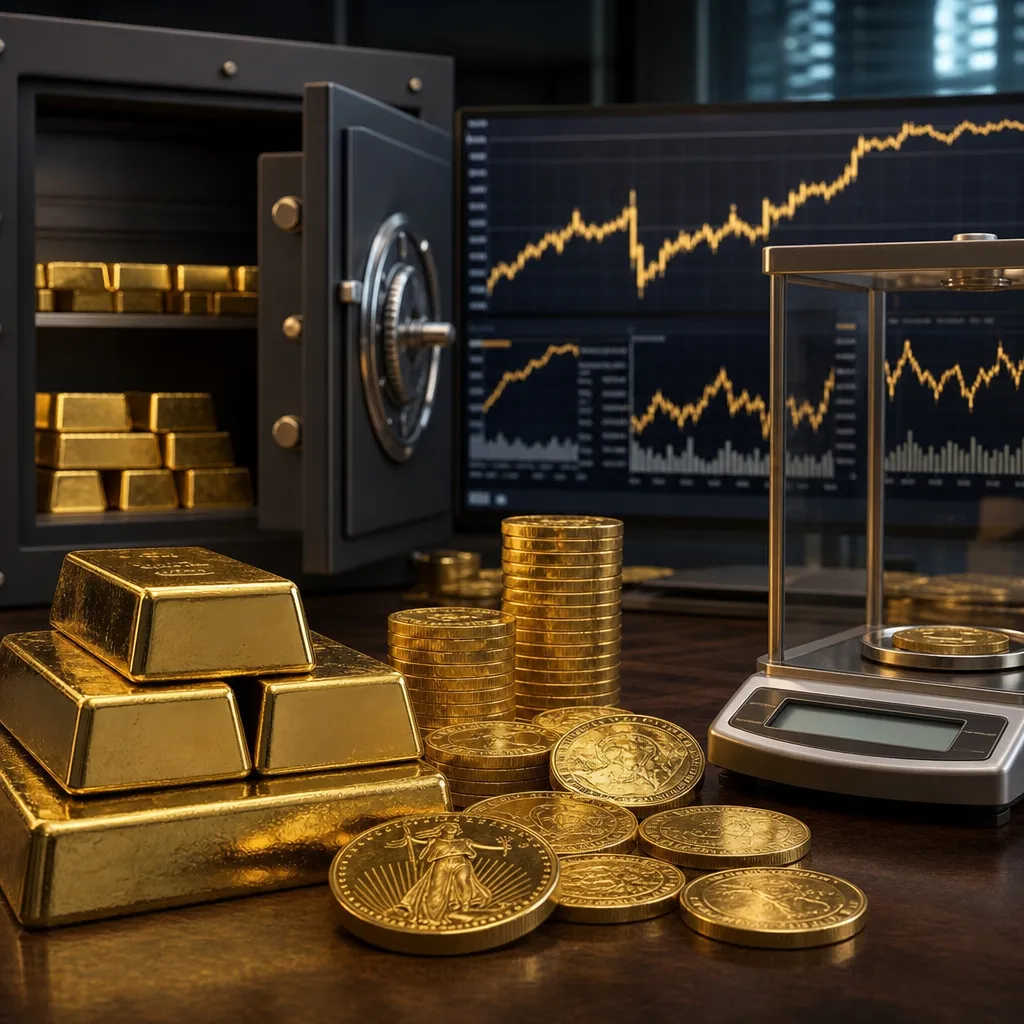
A gold price record high means gold has climbed to its highest level ever in a given currency and market convention, usually quoted per troy ounce in U.S. dollars. For investors, savers, and anyone tracking inflation or financial stress, a new high matters because it often signals a major shift in real yields, currency conditions, risk sentiment, or central bank behavior. It does not automatically mean gold is “expensive” in every sense, but it does mean the market is assigning unusually strong value to liquidity, scarcity, and portfolio protection. The key is to understand why gold is making a record, what could sustain it, and what could reverse it.
What a gold price record high actually means
When headlines say gold has hit a record high, they usually refer to the spot price or front-month futures price in U.S. dollars per troy ounce. That is important because gold can be at a record in one currency and not in another. For example, a weaker local currency can push domestic gold to all-time highs even if the international dollar price is below its prior peak.
A record also depends on the measure being used. Spot gold, COMEX futures, retail coin prices, and jewelry prices are related, but they are not identical. Retail bullion products can trade well above spot because of fabrication costs, dealer margins, logistics, and temporary shortages.
Why gold reaches record highs
Gold usually makes new highs when several supportive forces align rather than from one single cause. The most important drivers tend to be falling or expected-falling real yields, a weaker U.S. dollar, safe-haven demand, central bank buying, and expectations of easier monetary policy.
The table below summarizes the main forces behind a gold price record high.
| Factor | Typical Effect on Gold | Why It Matters |
|---|---|---|
| Falling real yields | Usually supportive | Gold does not pay interest, so lower inflation-adjusted returns on bonds reduce the opportunity cost of holding it. |
| Weaker U.S. dollar | Often supportive | Gold is commonly priced in dollars, so a softer dollar can make it cheaper for non-dollar buyers and improve demand. |
| Geopolitical or financial stress | Often supportive | Investors may seek assets perceived as liquid and defensive during crises or policy uncertainty. |
| Central bank gold demand | Supportive over time | Official sector buying can reinforce long-term demand and reserve diversification away from other assets. |
| Expectations of easier monetary policy | Usually supportive | Markets may anticipate lower rates, slower tightening, or greater liquidity, which can help precious metals. |
| Strong ETF and investment flows | Potentially supportive | Rising investor allocations can amplify price moves, especially when momentum and macro narratives align. |
The main takeaway is that record highs are usually macro-driven. They often reflect broad financial conditions more than immediate changes in mine supply or jewelry demand.
The role of real yields, interest rates, and bond markets
One of the most important mechanisms behind a gold price record high is the level of real yields. Real yields are roughly nominal bond yields minus inflation expectations. When real yields fall, bonds become less attractive in inflation-adjusted terms, which tends to support gold.
This is why the statement “higher rates are bad for gold” is too simplistic. If nominal rates rise because inflation is rising even faster, real yields may still fall, and gold can still strengthen. Conversely, if inflation is falling and central banks remain restrictive, real yields can rise and pressure gold even if nominal rates are stable.
Investors should watch not just policy rates, but also Treasury yields across the curve, inflation breakevens, and the market’s expectations for future central bank moves. Gold often reacts to the direction of expectations as much as to current policy settings.
Why the U.S. dollar and central banks matter
The international gold market is heavily tied to the U.S. dollar. An inverse relationship is common, though not perfect. When the dollar strengthens sharply, gold can struggle because it becomes more expensive in many other currencies. When the dollar weakens, gold often finds support.
Central banks matter for a different reason: their gold demand is strategic rather than speculative. Reserve managers may buy gold to diversify away from concentrated currency exposure, reduce sensitivity to sanctions risk, or improve confidence in reserve quality. This kind of demand can help support gold even when private investment flows are mixed.
That said, central bank buying alone does not guarantee continuous price increases. It is one pillar of demand, not the entire story.
Record high does not mean every gold product is priced the same
A headline record refers to the benchmark market, not necessarily to what a retail buyer will pay. Physical bars and coins trade at premiums to spot, and those premiums can widen during periods of heavy demand or constrained supply chains.
The differences are practical and often misunderstood.
| Price Type | What It Represents | Who Uses It | Practical Importance |
|---|---|---|---|
| Spot price | Benchmark wholesale price for immediate market reference | Traders, analysts, institutions | Main headline price, but not the final retail purchase price |
| Futures price | Exchange-traded contract price for future delivery | Hedgers, speculators, institutions | Can lead price discovery and reflect expectations, carry, and positioning |
| Retail bullion price | Spot plus premium, margin, fabrication, and distribution costs | Coin and bar buyers | Actual out-of-pocket price for physical ownership |
| Bid price | Price a dealer or market participant will pay to buy | Sellers, dealers | Relevant when exiting a position |
| Ask price | Price a dealer or market participant will charge to sell | Buyers, dealers | Relevant when entering a position |
The key point is simple: a gold price record high in spot terms does not tell you the exact price of coins, bars, jewelry, or scrap gold.
Does a record high mean gold is overvalued?
Not necessarily. A record high means the market price is the highest on record, but it does not by itself prove overvaluation. An asset can make repeated all-time highs if the macro backdrop keeps improving for that asset. Equities do this regularly; gold can as well.
The better question is whether the drivers behind the move are durable. If gold is rising because real yields are falling, the dollar is weakening, central banks are buying, and geopolitical stress remains elevated, a new high may be fundamentally supported. If the move is mostly momentum-driven after a crowded speculative surge, it may be more vulnerable to pullbacks.
Valuation in gold is also different from valuation in equities. Gold does not produce cash flow, so there is no price-to-earnings ratio. Analysts instead look at macro context, inflation-adjusted historical levels, currency strength, investor positioning, and relative attractiveness versus bonds and cash.
What can happen after a gold price record high
After breaking to a new high, gold can either consolidate, continue trending upward, or reverse sharply. Which path occurs depends on whether fresh buyers keep entering the market and whether the underlying macro drivers remain supportive.
The scenarios below are more useful than a single-point prediction.
| Scenario | Conditions | Possible Implication for Gold |
|---|---|---|
| Bullish continuation | Real yields fall, policy easing expectations increase, central bank demand stays firm, risk sentiment weakens | Gold could extend the breakout and establish a higher trading range |
| Base case consolidation | Supportive long-term backdrop remains, but momentum cools and positions reset | Gold may move sideways or pull back modestly before the next directional move |
| Bearish reversal | Real yields rise, the dollar strengthens, inflation fears ease, and safe-haven demand fades | Gold could retreat from highs, especially if speculative positioning was stretched |
The most common mistake is assuming a breakout guarantees immediate further upside. Strong trends can continue, but even structurally bullish markets often experience sharp corrections.
What investors and traders should watch next
After a gold price record high, the market’s next move usually depends less on the headline itself and more on follow-through. Investors should monitor a small set of variables rather than reacting to news flow alone.
- Real yields: one of the clearest macro inputs for gold.
- U.S. dollar direction: especially broad dollar strength or weakness.
- Central bank communication: whether policy is likely to stay tight or become easier.
- ETF and futures positioning: to gauge whether the move is broad-based or crowded.
- Geopolitical risk: not every crisis lifts gold, but persistent uncertainty can help.
- Physical demand and premiums: especially if retail or regional buying becomes a stronger support factor.
Traders may also watch whether the breakout holds on pullbacks. In many markets, prior resistance can become support, but that principle is not guaranteed.
Risks and limitations of chasing record highs
Buying gold at a record high is not inherently wrong, but it comes with obvious timing risk. Strong headlines can attract late buyers after much of the move has already happened. If macro conditions shift even slightly, gold can correct despite a positive long-term thesis.
There is also a difference between owning gold for strategic diversification and buying it for a short-term momentum trade. A long-term allocation may be judged by portfolio role, liquidity, and diversification. A short-term trade depends far more on entry level, volatility, and risk management.
Another limitation is that gold is not a perfect hedge. It can rise during inflation scares, policy stress, and market disruptions, but it can also fall during liquidity squeezes, periods of rising real yields, or broad dollar strength. Record highs do not remove those risks.
FAQ
What usually causes a gold price record high?
The most common combination is lower real yields, a softer U.S. dollar, strong safe-haven demand, supportive central bank buying, and expectations of easier monetary policy. A record high is usually the result of several forces aligning rather than one isolated event.
Does a record high mean gold will keep rising?
No. Gold can continue higher after a breakout, but it can also consolidate or correct. The next move depends on whether the underlying drivers remain supportive and whether the market has become overcrowded.
Is gold at a record high in every currency at the same time?
Not necessarily. Gold may be at a record in one currency but not in another because exchange rates matter. A weaker domestic currency can produce a local all-time high even if the U.S. dollar gold price is below its previous peak.
Why is physical gold more expensive than the spot price?
Physical bars and coins include fabrication, transport, insurance, distribution costs, and dealer margins. During periods of strong retail demand, premiums can rise further above spot.
How do interest rates affect gold at record highs?
The more useful measure is real interest rates rather than nominal rates alone. If real yields rise, gold may face pressure. If real yields fall because inflation expectations rise or policy easing becomes more likely, gold may stay well supported.
Should investors buy gold after it reaches a record high?
That depends on their objective, time horizon, and risk tolerance. For strategic diversification, the focus is on portfolio role rather than headlines. For short-term trading, entry timing and downside risk matter much more.
Can gold fall even during crises?
Yes. In some stress episodes, investors sell gold temporarily to raise liquidity, meet margin calls, or move into cash and dollars. Gold often behaves as a defensive asset over time, but not in a perfectly linear way.
Sources
- World Gold Council – gold market research and demand analysis
- LBMA – gold benchmark and wholesale market information
- Federal Reserve Economic Data (FRED) – interest rate, yield, and macroeconomic data