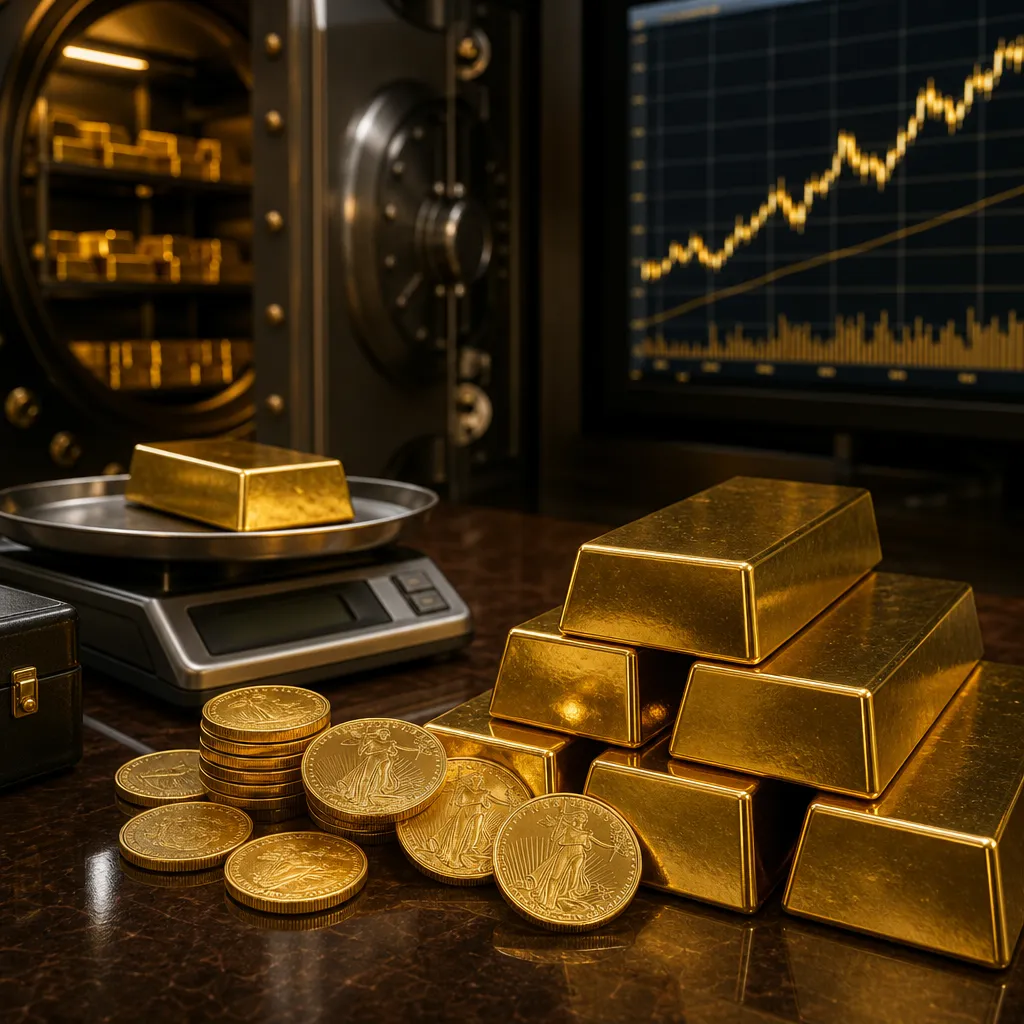
The gold price per kilo in EUR is the value of one kilogram of gold quoted in euros. For most readers, the key point is that this is usually derived from the international wholesale gold price and then translated into euros using the EUR/USD exchange rate, because gold is primarily priced in U.S. dollars in global markets. What matters in practice is that the number you see for a kilo of gold is not always the same as the amount you would actually pay for a 1 kg gold bar, because dealer premiums, spreads, fabrication costs, and local market conditions also matter.
If you are tracking the gold price per kilo in EUR, you are usually trying to answer one of three questions: what the market price of gold is in euro terms, why that euro price is moving, and how close that quoted price is to the real purchase or sale price of physical bullion. This article focuses on those practical differences and the main drivers behind them.
What “gold price per kilo in EUR” actually means
In the wholesale market, gold is usually discussed in troy ounces, not kilograms. A quoted gold price per kilo in EUR is therefore a conversion: first from the international gold benchmark or spot price, then from ounces into kilograms, and finally from U.S. dollars into euros if the original market quote is in USD.
One kilogram equals 32.1507 troy ounces. So, in simple terms, the euro price of one kilo of gold depends mainly on two things:
- the global gold price per troy ounce, and
- the EUR/USD exchange rate.
This means gold can rise in EUR even if the dollar gold price is flat, simply because the euro weakens against the dollar. The opposite is also true: euro strength can offset part of a rise in the international gold price.
How the EUR kilo gold price is formed
The mechanics are straightforward, but the implications are important for investors and bullion buyers.
| Component | Effect on gold price per kilo in EUR | Why it matters |
|---|---|---|
| International gold price | Direct | The base value of gold is set in deep global markets, especially spot and futures trading. |
| EUR/USD exchange rate | Direct | Because gold is globally quoted in USD, the euro value changes when the currency pair moves. |
| Weight conversion | Mechanical | One kilogram equals 32.1507 troy ounces, so the ounce price must be converted into kilo terms. |
| Dealer premium | Raises retail buy price | Physical bars include fabrication, logistics, distribution, and dealer margin. |
| Bid-ask spread | Creates buy/sell difference | The price at which you can buy is normally higher than the price at which you can immediately sell. |
| Local taxes or rules | Market-specific | Depending on jurisdiction and product type, taxes or regulatory costs can influence the all-in price. |
The main takeaway is that the quoted market value of a kilo of gold in euros is a benchmark, not automatically the final transactional price for a physical bar.
Spot gold price versus physical gold bar price
Many readers assume that if they see a “gold price per kilo in EUR,” they can buy a 1 kg bar at exactly that level. In reality, that quoted figure usually refers to the underlying bullion value, often close to the spot market or wholesale benchmark. Physical products almost always trade at a premium to that value.
A retail buyer of a 1 kg gold bar may pay more because the dealer must cover refining, minting or fabrication, transport, insurance, inventory costs, and operating margin. On the sell side, the dealer will usually buy back below the mid-market benchmark. That difference is the spread.
For larger, highly liquid bars, premiums are often lower in percentage terms than for small bars or coins, but they do not disappear. A 1 kg bar generally offers more efficient pricing than many smaller products, yet it still trades above raw spot value at purchase.
Why the gold price per kilo in EUR moves
The euro gold price is shaped by both gold-market forces and currency-market forces. That is the central point for anyone following gold in Europe.
| Driver | Typical effect on EUR gold price | Mechanism |
|---|---|---|
| Rising global gold price | Usually positive | Higher international bullion prices lift the euro-denominated value unless currency moves offset it. |
| Weaker euro vs U.S. dollar | Usually positive | A weaker euro means each dollar of gold value converts into more euros. |
| Stronger euro vs U.S. dollar | Usually negative | A stronger euro reduces the euro value of a given USD gold price. |
| Falling real yields | Often positive | Lower inflation-adjusted yields can make non-yielding gold relatively more attractive. |
| Higher real yields | Often negative | Higher real returns on bonds can increase the opportunity cost of holding gold. |
| Geopolitical stress | Often positive | Safe-haven demand can support gold, though the reaction is not always immediate or uniform. |
| Central bank demand | Potentially supportive | Official-sector buying can strengthen long-term demand for bullion. |
The most practical insight is that euro-based gold investors are taking exposure to both bullion and foreign exchange dynamics, even if they do not think of it that way.
The role of the EUR/USD exchange rate
For a euro-area investor, the exchange rate is often the most overlooked variable. Gold may be stable in dollars but rise in euros if the euro depreciates. That makes the gold price per kilo in EUR partly a precious-metals story and partly a currency story.
This matters especially during periods when U.S. monetary policy and euro-area monetary policy diverge. If U.S. rates rise relative to euro-area rates, the dollar may strengthen, which can boost the euro price of gold even if USD gold is not making a dramatic move. Conversely, a stronger euro can dampen local gold performance.
That is why two investors following the “same” gold market can experience different returns depending on their home currency.
How to estimate the benchmark gold price per kilo in EUR
If you want a rough benchmark rather than an exact retail quote, the logic is simple:
- Start with the international gold price per troy ounce.
- Multiply by 32.1507 to convert one ounce into one kilogram.
- Convert from USD into EUR using the prevailing exchange rate if needed.
This gives an indicative bullion value for one kilo of gold in euros. It is useful for comparison, portfolio tracking, and understanding whether dealer quotes are broadly reasonable.
But it is still only a benchmark. The actual invoice price for a kilo bar may differ because of product brand, bar type, custody arrangement, dealer inventory, and local market spreads.
What buyers of 1 kg gold bars should watch closely
When the product in question is a kilo bar, market structure becomes more important than many first-time buyers expect. A 1 kg bar is a professional-sized bullion product, so liquidity, authenticity, and resale conventions matter.
- Bar accreditation: Widely recognized refiners and accepted bar formats usually improve resale conditions.
- Premium over spot: A lower premium can make a large difference on a kilo-sized purchase.
- Buyback terms: The resale side matters just as much as the purchase side.
- Storage: Holding a kilo bar privately introduces security and insurance considerations.
- Documentation: Invoice, serial number, and certificate practices can affect future liquidity.
For many buyers, the relevant question is not just “What is the gold price per kilo in EUR?” but “What is my all-in entry price, and what price could I realistically exit at?”
What can cause differences between quoted EUR gold price and dealer quotes?
It is normal for the market quote and the dealer quote to differ. That difference does not automatically mean the dealer price is unreasonable.
| Reason for difference | How it affects the quote | Practical significance |
|---|---|---|
| Fabrication cost | Raises retail price | Even standard bars must be refined, cast, stamped, and handled. |
| Distribution and logistics | Raises retail price | Shipping, vaulting, insurance, and inventory carrying costs are real inputs. |
| Dealer spread | Raises buy price and lowers sell price | This is part of how bullion dealers manage risk and earn margin. |
| Product liquidity | Can narrow or widen spreads | Well-known bars usually trade more efficiently than obscure products. |
| Market volatility | May widen premiums and spreads | In stressed conditions, physical market frictions can increase sharply. |
| Tax treatment | Depends on jurisdiction | The tax outcome can affect the true total cost or resale economics. |
The key takeaway is that the spot-equivalent kilo value is a reference point, while the tradable price depends on the physical market channel you use.
Is the gold price per kilo in EUR more useful than per ounce or per gram?
That depends on the user. Wholesale market participants, analysts, and financial media still commonly think in troy ounces. Retail jewelry buyers often think in grams. Investors considering large bars may prefer kilo pricing because it aligns directly with the product they want to buy.
Kilo pricing is especially practical for:
- buyers comparing 1 kg bullion bars,
- European investors tracking gold in their home currency,
- portfolio reporting for larger physical positions, and
- institutional or semi-professional bullion comparisons.
For smaller purchases, gram pricing is often easier to interpret. For global macro analysis, ounce pricing remains the standard reference.
Limitations and common misunderstandings
The most common mistake is to treat the euro gold price per kilo as if it were a single, universally tradable number. It is not. It is a market reference that becomes a transaction price only after product, dealer, location, and spread are taken into account.
Another misunderstanding is to assume that euro gold performance reflects only gold-market sentiment. In fact, EUR pricing also incorporates currency effects. A euro investor who owns gold is not only exposed to bullion fundamentals such as real yields, central bank demand, and risk aversion, but also to movements in the euro against the dollar.
Finally, larger units do not eliminate risk. A kilo bar may offer lower percentage premiums than smaller items, but it also concentrates value in a single unit, which can affect flexibility, storage, and resale choices.
FAQ
How is the gold price per kilo in EUR calculated?
It is generally derived from the international gold price per troy ounce, converted into kilograms using 32.1507 troy ounces per kilo, and then translated into euros using the relevant exchange rate if the original quote is in U.S. dollars.
Why can gold rise in EUR even if gold is flat in USD?
If the euro weakens against the U.S. dollar, the same dollar-denominated gold price converts into a higher euro value. Currency movements can therefore boost the euro gold price even without a major change in the global bullion price.
Is the quoted gold price per kilo in EUR the same as the price of a 1 kg gold bar?
No. The quoted price is usually a benchmark or spot-related reference. The actual price of a physical 1 kg bar normally includes dealer premium, distribution costs, and a bid-ask spread.
Why do physical gold bars cost more than spot gold?
Physical bullion involves refining, fabrication, transport, insurance, storage, and dealer operating costs. These factors create a premium above the underlying gold value.
What matters more for EUR gold investors: gold itself or the currency?
Both matter. The gold price per kilo in EUR reflects the underlying bullion market and the EUR/USD exchange rate. In some periods, currency movement can be as important as the gold move itself.
Do larger gold bars have lower premiums?
Often yes in percentage terms, but not always in absolute terms. A 1 kg bar is usually more efficient than many smaller bars or coins, yet it still trades above spot and below spot on resale depending on market conditions and dealer terms.
Is kilo pricing mainly relevant for physical gold buyers?
Mostly yes. Kilo pricing is particularly useful for investors comparing large bullion bars or measuring holdings in a practical European format. Analysts and traders, however, still often rely on ounce-based market quotes.
Sources
- LBMA – gold market and benchmark price information
- CME Group – gold futures contract and market information
- World Gold Council – gold market research and investment information