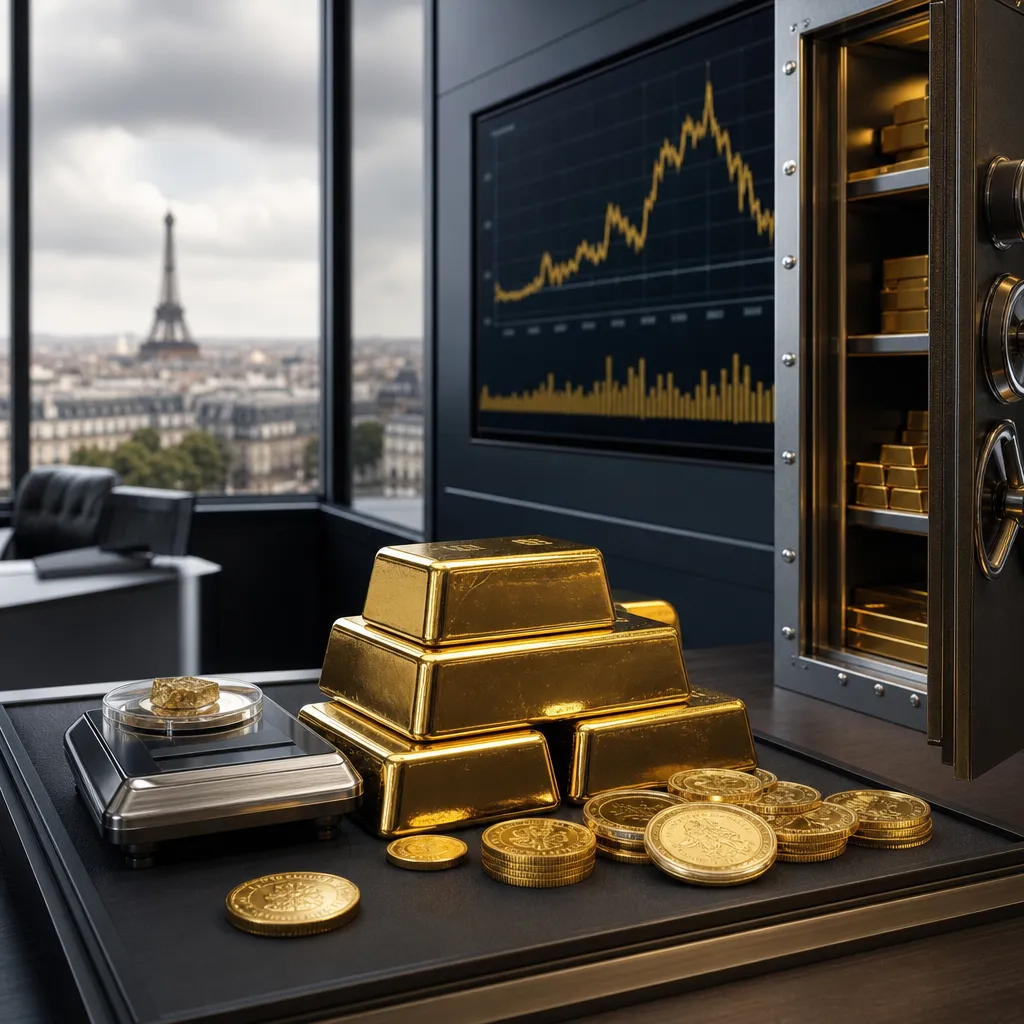
Gold price today in France usually refers to the market value of gold expressed in euros and then translated into the form a French buyer or seller actually sees: price per gram, per ounce, or per kilo, and often adjusted for bar, coin, or jewelry premiums. For most readers, the key point is simple: there is no single retail “France gold price” for every transaction. The international gold price, the EUR/USD exchange rate, product type, dealer spread, and local taxes or fees can all affect what you pay or receive.
If you are checking the gold price today in France, you are probably trying to answer one of three questions: what the underlying market is doing, what a French dealer may charge for physical gold, or what your own gold item may be worth. Understanding the difference between those three prices matters far more than staring at a headline quote alone.
What “gold price today in France” actually means
When financial media quote gold, they usually mean the international spot price for unallocated wholesale gold, commonly referenced in U.S. dollars per troy ounce. In France, that global benchmark is typically converted into euros and then into practical local units such as grams or kilograms.
However, most people in France do not buy institutional spot gold directly. They buy physical bullion products such as bars or coins from a dealer, or they sell jewelry or scrap gold. That is why the price you see on a website may differ from what you can actually transact at.
The table below shows the main building blocks of the gold price in France.
| Component | Effect on gold price in France | Why it matters |
|---|---|---|
| International spot gold price | Primary driver | This is the wholesale reference price for gold in global markets. |
| EUR/USD exchange rate | Can raise or lower euro gold prices | Gold is often priced globally in dollars, so euro buyers are exposed to currency conversion. |
| Weight unit | Changes the quoted amount | Gold may be shown per gram, troy ounce, or kilo; the unit affects readability, not intrinsic value. |
| Product premium | Usually increases retail purchase price | Bars and coins carry fabrication, logistics, inventory, and dealer margin costs. |
| Bid-ask spread | Creates a gap between buy and sell prices | The price at which you can sell is usually below the price at which you can buy. |
| Purity | Affects value per unit of weight | 24K bullion and lower-karat jewelry should not be valued the same way. |
| Taxes and transaction costs | May affect final all-in cost or proceeds | The treatment depends on product type and transaction structure, so assumptions should be checked carefully. |
The main takeaway is that the France gold price is not just a number from a chart. It is a pricing chain that starts in the global market and ends in a local transaction.
Why gold in France moves even when nothing local seems to change
Gold in France can rise or fall simply because the global market moved overnight in London, New York, or Asia. Since gold trades almost continuously through spot, futures, and over-the-counter wholesale markets, the euro price can change long before a French retail investor visits a dealer.
France-specific conditions can matter at the margin, especially in physical retail markets, but the main forces are usually international. A stronger dollar gold price, a weaker euro, or a shift in expectations for interest rates can all move the French gold price without any France-specific economic event.
The most important drivers of the gold price in euros
If you want to understand gold price today in France, focus on the euro gold price rather than only the dollar gold price. The same global gold move can feel very different to a French investor depending on what the euro is doing.
| Driver | Typical influence on gold in France | Mechanism |
|---|---|---|
| Higher global spot gold price | Usually positive | If wholesale gold rises, euro gold prices often rise as well unless currency moves offset the gain. |
| Stronger euro versus dollar | Can soften euro gold gains | A stronger euro means fewer euros are needed to buy the same ounce priced in dollars. |
| Weaker euro versus dollar | Can lift euro gold prices | Even if dollar gold is flat, gold can become more expensive in euros when the euro falls. |
| Rising real yields | Often negative for gold | Higher inflation-adjusted returns on bonds can increase the opportunity cost of holding non-yielding gold. |
| Falling real yields | Often supportive | When real returns on cash and bonds fall, gold may become relatively more attractive. |
| Geopolitical stress | Can be positive, but not always | Safe-haven demand may rise, though liquidity events can briefly pressure gold too. |
| Central bank demand | Medium-term support factor | Official-sector buying can strengthen the structural demand backdrop for gold. |
The crucial exception is that these relationships are not mechanical. Gold can rise despite higher yields if markets fear financial instability, and it can fall during a crisis if investors are forced to sell liquid assets.
Spot gold versus the price of physical gold in France
A common source of confusion is the difference between spot gold and the price of a physical coin or bar. Spot gold is the benchmark wholesale value of unfabricated gold in major markets. A French retail buyer, by contrast, usually pays spot plus a premium.
That premium reflects refining, minting, transport, insurance, storage, dealer overhead, and profit margin. During periods of strong retail demand or supply bottlenecks, premiums can widen noticeably even if the underlying spot price is stable.
Why the retail price is higher than spot
- Fabrication costs: Turning raw gold into minted bars or coins costs money.
- Distribution: Shipping, security, and inventory financing add to the final price.
- Dealer spread: Dealers quote both a buy and a sell price, not a single midpoint.
- Product scarcity: Popular coins or small bars can carry higher premiums than large bars.
For sellers, the reverse is also true: you usually receive less than spot because the buyer needs a margin and may face refining or resale costs.
Gold price per gram, ounce, and kilo in France
French buyers often compare gold by gram because it is intuitive for jewelry and small bullion products. Professional markets, however, still reference the troy ounce. Larger investors may look at kilo pricing, especially for bars.
These units represent the same underlying asset, just expressed differently. What matters is that you compare like with like: same purity, same product type, same side of the market, and same currency.
| Unit | Where it is commonly used | Practical note |
|---|---|---|
| Gram | Jewelry, scrap gold, small bars | Useful for retail buyers and sellers comparing small quantities. |
| Troy ounce | Global spot and futures market | This is the standard international benchmark unit for gold pricing. |
| Kilogram | Large bars and wholesale trade | More relevant for institutional or large-value transactions. |
Be careful not to confuse a troy ounce with a standard avoirdupois ounce. Gold markets use the troy ounce standard.
How purity affects the price in France
If you are evaluating bullion, purity is usually straightforward: many investment bars are very high purity, while coins vary by mint and specification. Jewelry is different. A gold necklace or ring is often 18K, 14K, or another alloy, not pure gold.
That means the value of the metal is based on its fine-gold content, not its total weight alone. Retail jewelry prices also include craftsmanship, branding, and design, while resale prices often reflect melt value minus deductions.
- 24K: Close to pure gold, typical for investment bullion.
- 18K: 75% gold, common in jewelry.
- 14K: Lower gold content, therefore lower melt value per gram than 18K or 24K.
So if you are searching “gold price today in France” for jewelry valuation, the market quote is only a starting point. You also need purity, exact weight, and the buyer’s deduction.
What French buyers and sellers should watch during the day
For practical decision-making, the first thing to monitor is whether you are looking at a tradable dealer quote or only a financial chart. A chart may show the wholesale market moving in real time, but it does not tell you what premium is attached to a specific bar or coin.
Second, watch the euro-dollar exchange rate. A French buyer can see local gold rise even when international headlines say gold is flat, simply because the euro weakened.
Third, distinguish investment bullion from jewelry and scrap. A one-kilo bar, a 1-ounce coin, and an 18K bracelet do not trade on the same basis.
Main risks and limitations when using today’s gold price
The biggest mistake is assuming the quoted market price equals your immediate transaction price. In reality, the final buy or sell price depends on the product, market liquidity, spread, and local commercial conditions.
Another limitation is timing. Gold can move sharply during U.S. market hours, after central bank announcements, or during risk-off events. A morning quote in France may be outdated by afternoon if markets are volatile.
There is also a difference between investment analysis and liquidation value. A person selling old jewelry may receive a price based on tested purity and recoverable metal, not on the headline gold chart.
How to interpret gold price today in France intelligently
The most useful way to read the gold price in France is to separate it into layers. First, identify the international gold trend. Second, check what the euro is doing against the dollar. Third, add the local realities of premiums, spreads, and purity.
If you are buying, compare the all-in price across reputable dealers and focus on total cost rather than headline spot. If you are selling, ask whether the quote is based on bullion resale, numismatic value, or melt value. Those are very different markets.
In short, the gold price today in France is best understood as global gold price translated into euros and then adjusted for the specific product and transaction. That framework avoids most common misunderstandings.
FAQ
Why is the gold price in France different from the U.S. dollar gold price?
Because French pricing is usually expressed in euros, not dollars. The local price reflects both the global gold market and the EUR/USD exchange rate.
Why is physical gold more expensive than spot gold in France?
Physical gold includes premiums for fabrication, transport, storage, insurance, inventory, and dealer margin. Spot gold is only the wholesale benchmark.
Does a stronger euro lower the gold price in France?
Often yes, all else equal. Since gold is commonly benchmarked in dollars, a stronger euro can reduce the euro-denominated cost of gold.
Is the gold price per gram in France the same for jewelry and bullion?
No. Bullion is valued mainly on purity, weight, and market premium. Jewelry includes design and labor when sold retail, but resale often depends mostly on melt value and purity testing.
What matters more for French investors: gold itself or the euro exchange rate?
Both matter. A move in spot gold is important, but euro strength or weakness can significantly change the local return experienced by a France-based investor.
Can I use today’s quoted gold price to estimate scrap gold value?
Only as a rough starting point. You also need the item’s purity, exact weight, and the deduction applied by the buyer or refiner.
Why does the gold price change throughout the day?
Gold trades in global markets almost continuously. Prices respond to futures activity, spot trading, currency moves, central bank expectations, bond yields, and geopolitical developments.
Sources
- LBMA – gold market benchmark and pricing information
- CME Group – gold futures market and contract information
- World Gold Council – gold market research and demand analysis