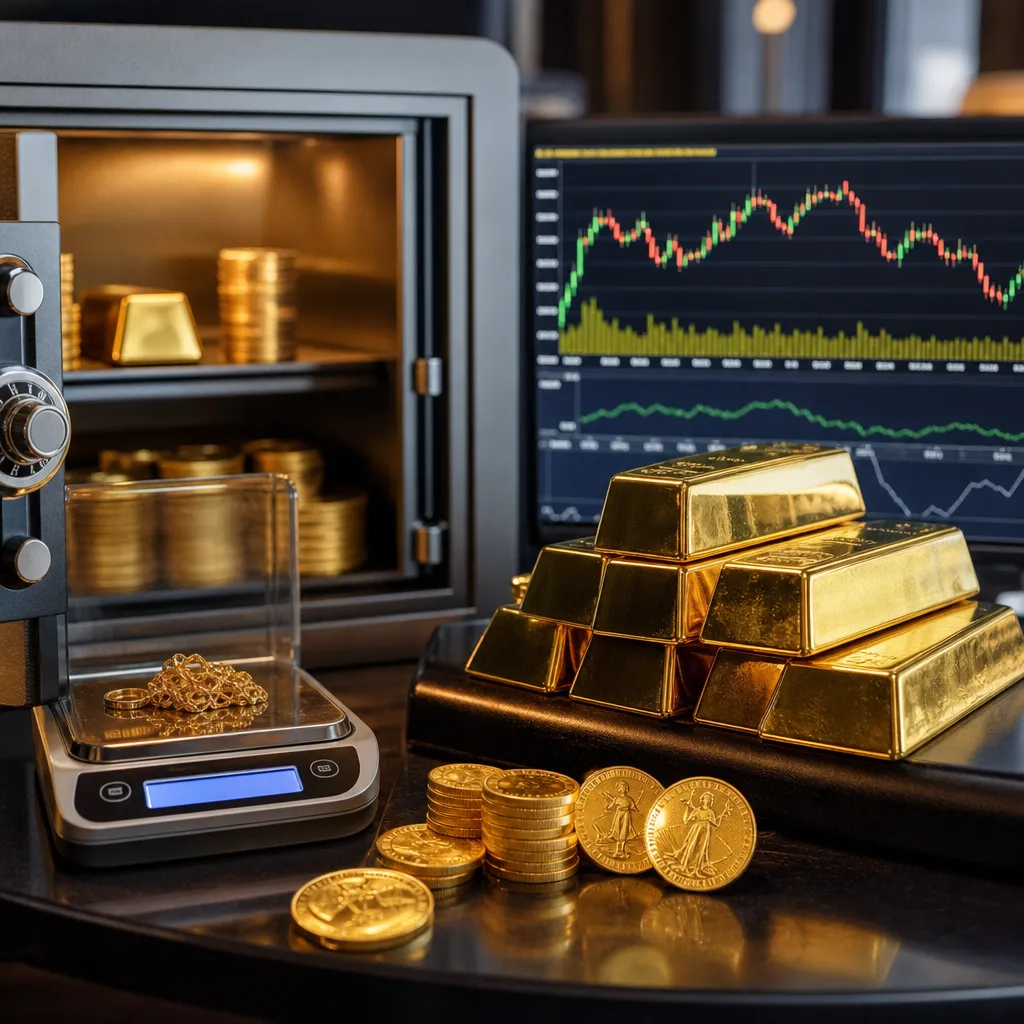
Gold price and stock market volatility are linked, but not in a simple one-direction rule. In broad terms, rising volatility in equities often increases interest in gold because investors may seek liquidity, diversification, or assets perceived as defensive. But gold does not automatically rise every time stocks fall, and stock market stress can sometimes hurt gold in the short term if investors are forced to raise cash. The key is to understand the mechanism: volatility affects risk appetite, interest rate expectations, the US dollar, real yields, and portfolio positioning, and all of those can matter for gold.
What “gold price and stock market volatility” really means
This topic usually refers to how gold behaves when equity markets become unstable. Stock market volatility is often understood as larger and faster price swings in indices such as the S&P 500, Nasdaq, or major global benchmarks. It can reflect fear about economic growth, earnings, credit conditions, monetary policy, or geopolitical risk.
Gold enters the picture because it is not a corporate claim on future profits. Unlike stocks, it does not depend directly on earnings growth or dividend expectations. That makes it a candidate for diversification when equity risk suddenly rises. However, gold is still a traded financial asset, so it can be influenced by funding stress, leverage reduction, and macro expectations just like other markets.
Why stock market volatility can support gold
When volatility rises, investors often reassess portfolio risk. This can support gold through several channels at the same time. The relationship is strongest when volatility reflects deeper macro stress, falling confidence in growth, or concern that policymakers may need to ease monetary conditions.
The table below shows the main transmission channels.
| Volatility Driver | Typical Pressure on Gold | Mechanism | Important Exception |
|---|---|---|---|
| Equity sell-off with risk aversion | Often positive | Investors may rotate toward assets viewed as defensive or diversifying. | If investors need immediate liquidity, gold can also be sold temporarily. |
| Falling growth expectations | Often positive | Slower growth can lower bond yields and increase expectations of easier monetary policy. | If deflation fears dominate and the dollar surges, gold may struggle. |
| Declining real yields | Often positive | Lower real yields reduce the opportunity cost of holding a non-yielding asset like gold. | If nominal yields fall but inflation expectations collapse faster, real yields may not help. |
| US dollar weakness during risk repricing | Often positive | Gold is commonly priced in dollars, so a weaker dollar can support the metal. | During global panic, the dollar can strengthen instead. |
| Portfolio diversification demand | Positive over time | Institutions may add gold to reduce concentration in equities and financial assets. | Correlation can rise temporarily in fast sell-offs. |
The main takeaway is that volatility helps gold most clearly when it leads to lower real yields, easier policy expectations, or sustained demand for portfolio hedges. Volatility by itself is not enough.
Why gold does not always rise when stocks become volatile
A common mistake is to assume gold should move opposite to stocks every day. In reality, market stress can create conflicting forces. During an acute sell-off, investors sometimes sell whatever they can, including profitable gold positions, to meet margin calls or reduce leverage.
This is why gold can drop alongside equities in the early phase of a sharp correction. If the stress then evolves from a liquidity event into a broader macro or policy event, gold may recover and begin behaving more like a defensive asset again. Timing matters.
Another complication is that stock volatility can come from reasons that are not especially gold-positive. For example, volatility caused by rising bond yields may pressure both stocks and gold at the same time, especially if higher real yields are the core driver.
The most important variables to watch alongside volatility
If you want to understand whether stock market volatility is likely to help or hurt gold, the best approach is to look beyond equity headlines. Gold often responds more directly to a small set of macro variables than to the stock market itself.
| Variable | Why It Matters for Gold | What to Watch During Equity Volatility |
|---|---|---|
| Real yields | They affect the opportunity cost of holding gold. | Are inflation-adjusted yields falling or rising? |
| US dollar | Gold is globally quoted in dollars, so currency moves influence price direction. | Is stress causing a dollar rally or dollar weakness? |
| Treasury yields | Falling yields can support gold if they reflect growth fears or policy easing expectations. | Are yields falling because of recession concerns or rising because of inflation and supply worries? |
| Monetary policy expectations | Gold often responds to expected rate cuts or looser financial conditions. | Is volatility making central banks look more dovish? |
| ETF and investment flows | Investor allocation trends can amplify or mute price moves. | Are investors adding to or reducing gold exposure? |
| Market liquidity stress | In severe stress, demand for cash can temporarily dominate safe-haven demand. | Are there signs of forced selling across asset classes? |
For practical analysis, this table is more useful than a simple “stocks down, gold up” rule. Gold tends to respond to the type of volatility, not just the existence of volatility.
Different kinds of stock market volatility produce different gold reactions
Not all volatility looks the same in macro terms. A growth scare, inflation scare, credit event, and speculative tech correction can all create turbulence in equities, but gold may react differently in each case.
Growth scare or recession fear
This is often the most supportive environment for gold, especially if bond yields fall and markets begin pricing in monetary easing. Gold may benefit from both lower real yields and defensive portfolio demand.
Inflation shock with rising yields
This is more mixed. If inflation rises but real yields rise too, gold’s response may be weaker than many expect. Higher rates can offset the inflation narrative.
Liquidity crisis
In abrupt funding stress, gold can sell off first with everything else. Later, if authorities inject liquidity or cut rates, gold can recover strongly. This two-stage pattern is important in crisis analysis.
Sector-specific equity weakness
If volatility is concentrated in one industry or a speculative segment of the market, gold may barely react. Gold responds more to systemic repricing than to narrow equity rotations.
How investors use gold when stock volatility rises
Gold can play several roles during equity turbulence, but those roles are not identical. Some investors use it as a crisis hedge, some as a longer-term diversification asset, and others as a macro trade tied to rates and the dollar.
- Portfolio diversifier: Gold may reduce dependence on equity-market outcomes, especially over longer periods.
- Defensive risk asset: In episodes of falling growth expectations and softer yields, gold may hold up better than cyclical assets.
- Policy-sensitive macro asset: Gold can react strongly when volatility changes expectations for Federal Reserve or central bank policy.
- Liquidity reserve in physical form: Some investors hold bullion for reasons that are broader than market performance, including asset diversification outside the financial system.
That said, the form of gold matters. Physical bullion, gold ETFs, gold futures, and gold mining stocks do not behave the same way during volatility. Mining stocks, for example, can decline with the broader equity market even if bullion is relatively resilient.
Gold versus gold mining stocks during equity stress
Investors often confuse exposure to gold with exposure to gold-related equities. They are connected, but they are not interchangeable. If the issue is stock market volatility, this distinction becomes especially important.
| Asset | Primary Driver | Typical Behavior in Equity Stress | Main Risk |
|---|---|---|---|
| Physical gold | Spot gold price, currency, and premiums | May benefit from safe-haven demand, though not always immediately | Storage, spreads, and no income |
| Gold ETF | Spot gold exposure through a fund structure | Usually tracks bullion more closely than mining shares | Fund structure and market trading costs |
| Gold mining stocks | Gold price plus equity-market sentiment, costs, operations, and management | Can fall with stocks even when gold is stable or rising | Operational, political, cost, and equity-market risk |
| Royalty and streaming companies | Exposure to mine output economics without direct mine operation | Often more defensive than miners, but still equity securities | Deal quality, concentration, and financing risk |
The practical lesson is simple: if the goal is insulation from stock volatility, bullion and bullion-backed products usually behave differently from equity-based gold exposure.
When the relationship tends to be strongest
The link between gold price and stock market volatility tends to strengthen under a recognizable set of conditions. Investors should look for clusters rather than a single indicator.
- Volatility is broad-based rather than limited to one sector.
- Real yields are falling or expected to fall.
- The market expects central bank easing or slower tightening.
- Credit spreads are widening and recession risk is increasing.
- The dollar is stable or weakening rather than surging sharply.
- Investors are actively seeking portfolio hedges, not just selling risky assets indiscriminately.
When several of these conditions appear together, gold’s defensive role is usually easier to observe.
When the relationship weakens or reverses
There are also clear cases where stock volatility does not help gold much, or may even coincide with weakness in gold prices.
- Rising real yields: If volatility comes from fears of tighter policy or persistently high inflation, higher real yields can weigh on gold.
- Dollar spikes: Global stress often creates demand for dollars, which can offset safe-haven interest in gold.
- Forced liquidation: Leveraged investors may sell gold to cover losses elsewhere.
- Short-term positioning: If speculative positioning in gold is already crowded, the metal can react poorly even during equity weakness.
- Inflation without policy relief: Inflation by itself is not enough if central banks stay restrictive and yields remain elevated.
This is why correlation analysis over short windows can be misleading. Gold should be evaluated in a broader macro framework.
What investors and traders should pay attention to
If you are monitoring gold during a volatile stock market, focus on market structure and macro confirmation rather than headlines alone. A practical checklist helps.
- Check real yields first. They often explain a large part of gold’s medium-term direction.
- Watch the dollar at the same time. A strong dollar can neutralize some of gold’s defensive appeal.
- Separate bullion from mining shares. They can diverge sharply during equity stress.
- Distinguish between a correction and a liquidity event. Gold’s reaction can be very different.
- Track policy expectations. Gold often responds when volatility changes the path markets expect from central banks.
- Be careful with short-term assumptions. Gold may hedge turbulence imperfectly over days even if it diversifies risk better over longer horizons.
FAQ
Does gold always rise when the stock market becomes volatile?
No. Gold often benefits from equity-market stress, but not always. It can fall during sharp sell-offs if investors need cash, if the US dollar jumps, or if real yields move higher.
Why can gold fall at the same time as stocks?
The usual reason is liquidity pressure. In fast market declines, investors may sell liquid assets, including gold, to meet margin calls or reduce leverage. Gold may recover later if the event leads to lower yields or easier policy expectations.
Is gold a good hedge against stock market volatility?
It can be a useful diversifier, but it is not a perfect day-to-day hedge. Its effectiveness depends on the cause of volatility, the behavior of real yields and the dollar, and the investor’s time horizon.
How do real yields affect gold during equity sell-offs?
Falling real yields often support gold because they reduce the opportunity cost of holding a non-yielding asset. If equity volatility leads investors to expect lower rates or weaker growth, that can be positive for gold.
Do gold mining stocks protect against stock market volatility like physical gold?
Not necessarily. Gold mining stocks are still equities, so they can decline with the broader stock market. Their performance depends not only on gold prices but also on operating costs, company quality, and overall equity sentiment.
What matters more for gold: stock volatility or the US dollar?
In many cases, the dollar and real yields matter more. Stock volatility influences gold mainly through these broader macro channels. A strong dollar or rising real yields can overpower the usual defensive case for gold.
Can gold perform well even if stocks are calm?
Yes. Gold can rise during relatively stable equity markets if real yields fall, the dollar weakens, central bank demand is supportive, or investors expect easier monetary policy.
Sources
- World Gold Council – gold market research and analysis
- Federal Reserve Economic Data (FRED) – interest rates, financial conditions, and market data
- CME Group – gold futures market information