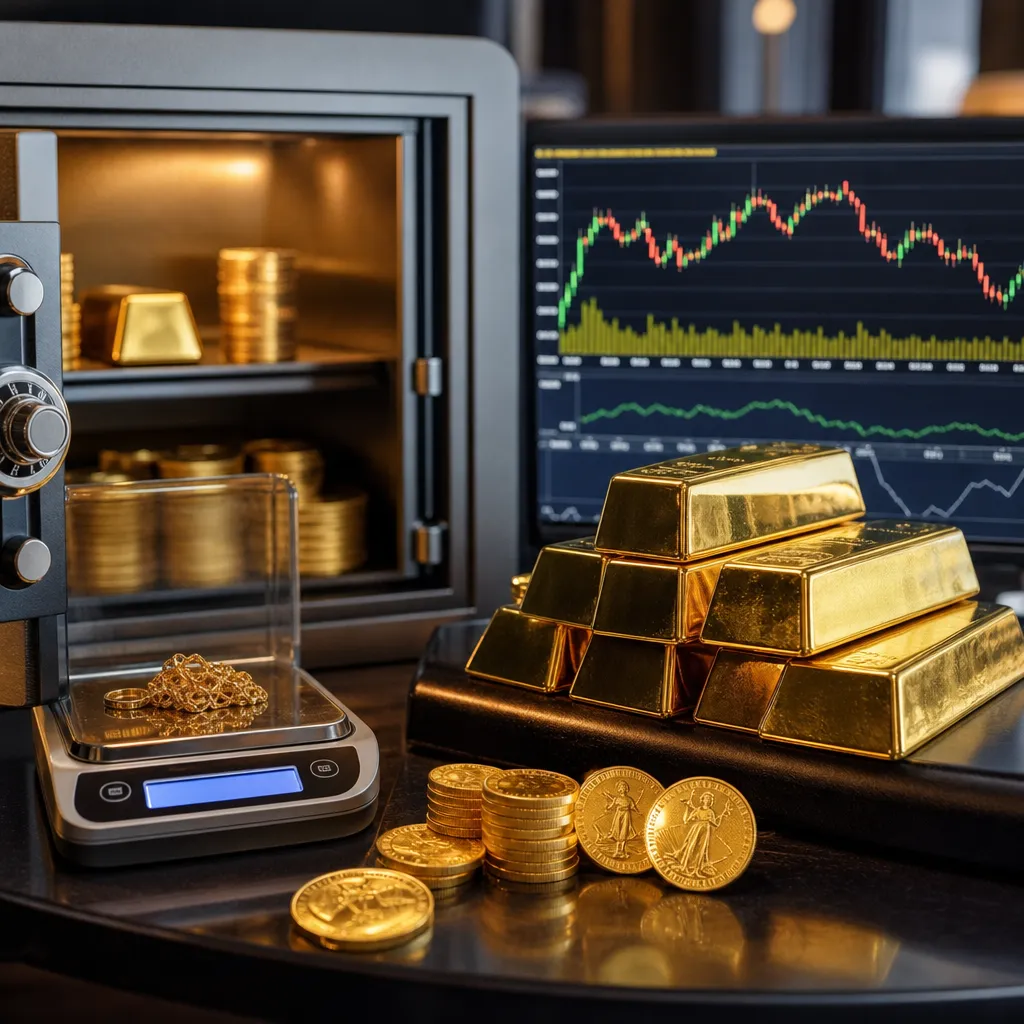
The gold price in GBP is the value of gold expressed in British pounds rather than in U.S. dollars. For most readers, the key point is simple: the pound price of gold is driven not only by the global gold market, but also by the GBP/USD exchange rate, retail premiums, product type, and the form in which gold is bought or sold. That is why the chart price quoted for gold in pounds often differs from what a UK buyer pays for a coin or bar.
If you want to understand gold in sterling, focus on three layers: the international wholesale gold price, the value of the pound against the dollar, and the costs added in the retail market. Together, these explain why gold can rise in GBP even when it is flat in USD, or fall less sharply in the UK than in other currencies.
What “gold price in GBP” actually means
When people search for the gold price in GBP, they may mean several different things:
- the spot gold price converted into pounds,
- the price per ounce, gram, or kilo in sterling,
- the retail price of physical bullion in the UK,
- or the resale value of gold items priced in pounds.
The most widely used benchmark in global markets is gold quoted per troy ounce. One troy ounce equals about 31.1035 grams. In practice, many UK investors also look at the pound price per gram, especially when comparing smaller bars, sovereigns, or scrap gold values.
A useful way to think about sterling gold pricing is shown below.
| Component | Effect on gold price in GBP | Why it matters |
|---|---|---|
| International gold price | Major driver | Gold is traded globally, usually referenced in U.S. dollars. |
| GBP/USD exchange rate | Major driver | A weaker pound usually makes gold more expensive in GBP, even if dollar gold is unchanged. |
| Weight unit | Changes quoted value | Price per gram, ounce, and kilo are different ways of expressing the same underlying market value. |
| Dealer premium | Raises retail purchase price | Physical bars and coins include fabrication, distribution, and dealer margin. |
| Bid-ask spread | Affects buy and sell prices | You usually buy above spot and sell below spot. |
| Product type and liquidity | Can widen or narrow retail pricing | Recognised coins and bars often trade more efficiently than niche products. |
The main takeaway is that there is no single “gold price in GBP” for every purpose. The chart price, the dealer buy price, and the resale price can all be different.
How gold is converted from USD into GBP
Gold is primarily priced in the international market in U.S. dollars per troy ounce. To estimate the gold price in pounds, the market converts that dollar value using the prevailing GBP/USD exchange rate.
Conceptually, the calculation works like this:
- Gold price in GBP per ounce = Gold price in USD per ounce ÷ GBP/USD exchange rate
If the pound strengthens against the dollar, the gold price in GBP may fall even when the USD gold price is stable. If the pound weakens, sterling gold can rise without any change in the global gold market.
This is one of the most important ideas for UK-based investors: owning gold in GBP is partly an exposure to gold and partly an indirect exposure to currency movement.
Why gold can move differently in GBP than in USD
Gold’s local-currency performance can look very different from its dollar performance. This happens because two prices are moving at once: gold itself and the pound.
For example, if global risk rises and investors buy dollars as well as gold, sterling can weaken while gold strengthens. In that case, the gold price in GBP may rise more sharply than the gold price in USD. The reverse is also possible if the pound rallies strongly.
The relationship can be summarized as follows.
| Market situation | Likely effect on gold in USD | Likely effect on GBP/USD | Possible result for gold in GBP |
|---|---|---|---|
| Gold rises, pound unchanged | Positive | Neutral | Gold in GBP usually rises |
| Gold flat, pound weakens | Neutral | Pound negative | Gold in GBP often rises |
| Gold rises, pound weakens | Positive | Pound negative | Gold in GBP may rise strongly |
| Gold falls, pound strengthens | Negative | Pound positive | Gold in GBP may fall more sharply |
| Gold rises, pound strengthens a lot | Positive | Pound positive | Gold in GBP may rise only modestly or even stay flat |
This is why UK investors should not rely only on headlines about the gold price in dollars. The sterling exchange rate can materially change the outcome.
Spot gold in GBP versus physical gold prices in the UK
The spot price is the reference price for gold in the wholesale market. It is not usually the final price paid by a retail buyer purchasing a gold coin or bar from a dealer.
Physical gold in the UK normally trades above spot because the buyer is paying for more than metal alone. Retail pricing may include:
- fabrication and refining costs,
- minting costs for coins,
- wholesale and retail distribution margins,
- storage, insurance, and logistics,
- market liquidity conditions and inventory constraints.
On the selling side, the dealer buyback price is often below the live spot equivalent. That difference is the spread. Highly liquid products from widely recognized refiners or sovereign mints often have tighter spreads than uncommon or collectable items.
This matters because an investor who checks the gold price in GBP on a chart and then buys a small bullion coin may find the actual purchase price noticeably higher. That is normal market structure, not necessarily overpricing.
Which factors matter most for gold priced in pounds
Several variables have a direct or indirect influence on gold in sterling terms. The most important are global gold drivers first, and pound-specific currency drivers second.
Global gold drivers
- Real interest rates: Higher real yields can pressure gold because they raise the opportunity cost of holding a non-yielding asset.
- Inflation expectations: Gold may benefit when investors worry that inflation will erode the value of cash and bonds.
- Monetary policy: Expectations around central bank rate cuts, tightening, or liquidity conditions can move gold significantly.
- Risk sentiment: Banking stress, recession fears, or geopolitical shocks can lift safe-haven demand.
- Central bank demand: Official-sector gold buying can support long-term interest in the metal.
Pound-specific drivers
- GBP/USD exchange rate: Often the most immediate local-currency driver after global gold itself.
- Bank of England policy expectations: These can affect sterling through interest-rate differentials and growth expectations.
- UK economic outlook: Weak growth or fiscal stress can pressure the pound, which may mechanically support gold in GBP.
- Global dollar strength: Because gold is internationally dollar-based, broad USD moves can spill directly into GBP pricing.
A practical implication follows: if you are monitoring the gold price in pounds, you should usually track both XAU/USD and GBP/USD, not just one chart.
What UK investors should watch in practice
If your reference currency is sterling, the most useful habit is to separate metal risk from currency risk. Gold might be performing well in GBP because the metal is strong, because the pound is weak, or because both are happening together.
Key indicators to watch include:
- the international spot gold price,
- the GBP/USD exchange rate,
- U.S. real yields and Treasury yields,
- Federal Reserve and Bank of England policy signals,
- ETF flows and broader investment demand for gold,
- retail premiums on the specific products you are considering.
For buyers of physical bullion, product choice matters almost as much as market timing. A large bar may track spot more closely than a small coin because its premium per gram is often lower. But coins can be more flexible and easier to sell in small quantities. The “best” option depends on whether your priority is low cost, divisibility, recognisability, or ease of resale.
Common misunderstandings about the gold price in GBP
One common mistake is assuming that sterling gold should always rise during periods of inflation in the UK. Inflation can support gold, but the final effect depends on real yields, monetary policy expectations, and the direction of the pound. If tighter policy lifts sterling and real yields, gold in GBP might not respond the way many expect.
Another misunderstanding is treating the quoted market price as the same as a retail purchase price. It is not. A one-ounce bullion bar, a fractional coin, a jewellery item, and scrap gold can all have very different sterling prices even if they contain similar amounts of gold.
A third mistake is looking only at short-term moves. Gold in GBP can be volatile over weeks or months because both gold and currency markets are moving. For that reason, short-term sterling price fluctuations do not automatically confirm or invalidate gold’s longer-term role in a portfolio.
Limitations and risks
Gold priced in pounds is not a one-way trade and should not be treated as a guaranteed hedge. It can fall if global gold weakens, if real yields rise, or if the pound strengthens sharply. Investors who buy physical gold must also consider premiums, storage, insurance, and resale spreads.
There is also a timing risk. Buying after a sharp rally in sterling gold can expose the buyer to both a gold pullback and a currency reversal. Conversely, waiting for a lower GBP price can be difficult if the pound is under pressure and global gold remains firm.
For investors using ETFs or derivatives rather than physical bullion, the risk set changes. Liquidity may improve, but there may be fund structure considerations, tracking issues, currency exposure nuances, and, in the case of leveraged instruments, significantly higher risk.
FAQ
Why does the gold price in GBP differ from the gold price in USD?
Because the pound price reflects both the global gold market and the GBP/USD exchange rate. Even if gold is unchanged in dollars, a weaker pound can make gold more expensive in sterling.
Does a weaker pound always push gold higher in GBP?
Often, but not always. A weaker pound usually supports the sterling gold price mechanically, yet a sufficiently large fall in global gold can still outweigh the currency effect.
Is the spot gold price in GBP the same as the price I pay for coins or bars?
No. Spot is the wholesale reference price. Physical products usually cost more because of fabrication, distribution, dealer premium, and market spread.
Should UK investors track Bank of England policy or Federal Reserve policy?
Both matter. Federal Reserve policy strongly influences global gold through real yields and the dollar, while Bank of England policy can affect sterling and therefore the local gold price in GBP.
Can gold rise in GBP even if gold is not rising globally?
Yes. If the pound weakens enough against the dollar, the sterling price of gold can rise even when the international gold price is flat.
What is the most useful unit for checking the gold price in GBP?
It depends on your purpose. Investors often follow the ounce price because it aligns with the global market, while buyers of smaller products may prefer the price per gram for easier comparison.
Why is a small gold coin often more expensive per gram than a larger bar?
Smaller products usually carry higher fabrication and retail costs relative to their metal content. Their flexibility and recognisability can be useful, but they often come with a higher premium.
Sources
- LBMA – gold market benchmark and pricing information
- World Gold Council – gold market research and investment education
- Bank of England – monetary policy and sterling market information