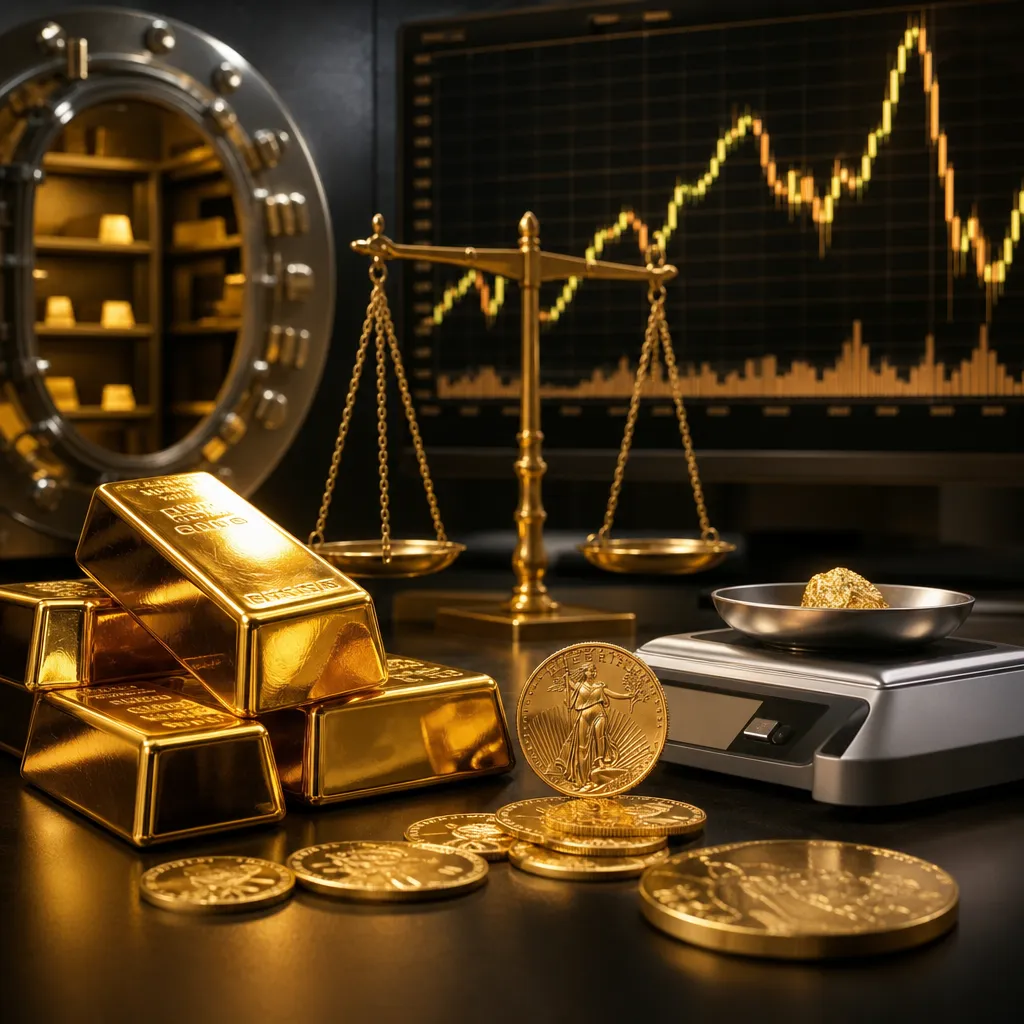
Gold prices change every second because gold is traded continuously in highly liquid global markets where buyers and sellers constantly react to new information, changing expectations, and shifting order flow. What looks like “the gold price” is really a live market price shaped by futures exchanges, spot market dealing, currency moves, interest-rate expectations, and sudden changes in risk sentiment. For investors, traders, and even jewelry buyers, understanding this process matters because a quoted gold price is not a fixed value handed down from one source. It is a moving market equilibrium.
The short answer is simple: gold’s price updates whenever the balance between immediate buying and selling changes. The more useful answer is that this balance moves constantly because gold sits at the intersection of macroeconomics, finance, currencies, central bank behavior, and market mechanics. That is why gold can react not only to inflation data or war headlines, but also to bond yields, the US dollar, ETF flows, and changes in futures positioning.
What “gold price” usually means
When people say gold is up or down, they are usually referring to a benchmark market price for wholesale gold, most often quoted per troy ounce in US dollars. In practice, several related prices exist at the same time: spot gold, futures prices, bid prices, ask prices, and retail prices for bars and coins.
These prices are connected, but they are not identical. A retail buyer of a one-ounce bullion coin pays more than the spot quote because fabrication, distribution, dealer markup, and local market conditions are added on top.
| Term | What It Represents | Why It Changes Constantly |
|---|---|---|
| Spot gold | The current wholesale market price for gold for near-immediate settlement | Updates as dealers and institutions adjust quotes to market supply, demand, and arbitrage conditions |
| Gold futures | Exchange-traded contracts for future delivery or cash settlement | Moves with trader positioning, hedging, interest-rate expectations, and liquidity |
| Bid price | The highest current price a buyer is willing to pay | Changes as buying interest and order flow shift |
| Ask price | The lowest current price a seller is willing to accept | Adjusts with liquidity, volatility, and dealer inventory conditions |
| Retail bullion price | The price paid by end buyers for coins or bars | Moves with spot price plus premium, fabrication costs, and dealer spreads |
The main takeaway is that there is no single frozen gold value. There is a live trading price at the wholesale level, and that price is constantly recalculated by the market.
Why prices can move every second
Gold trades in a global network rather than on one isolated local market. Activity in futures markets such as COMEX, over-the-counter dealing in the London market, ETF creations and redemptions, and trading across Asia, Europe, and North America all feed into price discovery.
If a large institution decides to buy futures contracts, if the US dollar suddenly weakens, or if Treasury yields fall after an inflation report, gold may reprice almost instantly. Modern electronic markets allow this to happen in seconds rather than hours.
At the most basic level, every price change reflects one thing: the market finding a new clearing price where the next transaction can occur. If aggressive buyers lift offers, price rises. If aggressive sellers hit bids, price falls. This can happen many times in a minute.
The main forces behind second-by-second gold price changes
Gold is influenced by more variables than many other assets because it is part currency hedge, part macro asset, part crisis hedge, and part commodity. Some drivers work through investment demand, others through the opportunity cost of holding gold, and others through fear or liquidity.
| Factor | Typical Pressure on Gold | Mechanism | Important Exception |
|---|---|---|---|
| Falling real yields | Often supportive | Lower inflation-adjusted returns on bonds reduce the opportunity cost of holding non-yielding gold | Gold may still fall if investors sell broadly for liquidity |
| Rising real yields | Often negative | Higher real returns on interest-bearing assets can make gold less attractive | Geopolitical fear can offset the pressure |
| Weaker US dollar | Often supportive | Gold priced in dollars becomes relatively cheaper for non-dollar buyers | Correlation is common, not guaranteed |
| Stronger US dollar | Often negative | Dollar strength can tighten financial conditions and pressure commodity prices | Gold and the dollar can rise together during some crises |
| Higher inflation expectations | Can be supportive | Investors may seek stores of value if they expect fiat purchasing power to weaken | If central banks respond with sharply higher real rates, gold may struggle |
| Safe-haven demand | Often supportive | Political or financial stress can increase demand for defensive assets | In a cash squeeze, investors may initially sell gold too |
| ETF inflows | Typically supportive | More investment demand can tighten available market supply and reinforce bullish sentiment | Short-term futures flows can dominate the immediate move |
| Central bank buying | Generally supportive over time | Official-sector demand can add structural support to the market | Its effect is usually more important over months than seconds |
This is why simple explanations such as “inflation makes gold go up” are incomplete. Gold reacts to inflation, but also to how central banks respond to inflation and how bond markets price that response.
Interest rates, real yields, and why they matter so much
One of the most important variables for gold is the level of real yields, meaning bond yields after adjusting for inflation expectations. Gold does not generate income, so investors constantly compare it with the real return available on cash and government bonds.
If real yields fall, holding gold becomes relatively less costly. If real yields rise, the opposite is often true. This relationship is one of the clearest reasons gold can reprice within seconds after a major macroeconomic release.
For example, if inflation data comes in softer than expected, markets may assume the central bank will be less aggressive. Bond yields may drop, the dollar may weaken, and gold may jump almost immediately. But if inflation surprises to the upside and markets expect tighter monetary policy, gold may first rise on inflation concern and then reverse lower as yields surge. That is why gold’s reaction is sometimes more complex than headlines suggest.
The role of the US dollar and currency conversion
Gold is primarily quoted in US dollars, so dollar movements matter. A weaker dollar often supports gold because buyers using euros, yen, pounds, or other currencies can effectively buy the same ounce more cheaply. A stronger dollar can have the opposite effect.
But the relationship is not mechanical. In some periods, both gold and the dollar rise together because both benefit from global risk aversion. During financial stress, investors may buy dollars for liquidity and gold for protection at the same time.
This also explains why gold may appear stable in dollars but move sharply in another currency. Local gold prices depend not only on the international gold market but also on exchange rates.
| Component | Effect on Local Gold Price | Practical Meaning |
|---|---|---|
| International gold price | Direct | If global gold rises, local prices usually rise too |
| Exchange rate | Direct | If the local currency weakens against the dollar, local gold can rise even if dollar gold is flat |
| Weight unit | Quotation difference | Gold may be shown per gram, troy ounce, or kilogram, which affects the visible number |
| Purity | Value difference | 24K bullion and lower-karat jewelry do not reflect the same gold content |
| Dealer premium | Retail markup | Physical products cost more than raw wholesale quotes |
The key point is that a person watching gold in a local currency may see minute-by-minute changes caused partly by the gold market and partly by foreign-exchange moves.
How market structure accelerates price changes
Gold price discovery is heavily influenced by futures trading, especially on large exchanges where leverage allows participants to take positions quickly. A hedge fund does not need to buy physical bars in a vault to express a view on gold; it can buy or sell futures contracts in seconds.
This matters because futures markets are deep, fast, and highly sensitive to news. When large volumes hit the market, prices can move before slower parts of the physical market react. Arbitrage then helps align related prices across futures, spot, ETFs, and wholesale physical markets.
Algorithmic trading also contributes to speed. Some systems react instantly to changes in yields, foreign exchange, or economic releases. That does not mean machines “set” gold prices alone, but it does mean new information gets reflected faster than in older market structures.
Why gold does not rise on every bullish-looking headline
Gold is often described as a safe haven, but real market behavior is more nuanced. In a geopolitical shock, gold may jump. In a banking scare, it may rise on systemic concerns. Yet in a violent selloff across all assets, investors sometimes sell gold to raise cash, meet margin calls, or reduce leverage.
That is why short-term moves can look irrational unless you understand the dominant force at that moment. One day the market may care most about inflation hedging. On another day it may care most about real yields. During a liquidity event, it may care most about immediate cash needs.
Short-term price action is often driven less by long-term valuation and more by positioning, liquidity, and urgency. Over longer periods, structural factors such as inflation trends, central bank demand, and monetary credibility matter more.
What investors and traders should watch
If you want to understand why gold is moving right now, watch the variables that institutions watch. Gold rarely moves in isolation.
- Real yields: often one of the clearest macro drivers.
- US dollar strength or weakness: especially broad dollar index moves.
- Central bank expectations: policy path matters more than the latest rate level alone.
- Inflation data: especially when it changes policy expectations.
- Risk sentiment: equity selloffs, banking stress, or geopolitical headlines can alter demand quickly.
- ETF and futures positioning: useful for understanding investment flow and speculative pressure.
- Physical premiums: relevant for buyers of coins and bars, since retail markets can decouple from spot temporarily.
For practical decision-making, it helps to separate price direction from price noise. Second-by-second moves may matter to a day trader, but a long-term investor may care more about whether the broader backdrop for gold is improving or deteriorating.
Limits of explanation: not every tick has one clear cause
It is tempting to explain every price move with a headline, but that can be misleading. Many short-term moves happen because of market microstructure: stop-loss orders, option hedging, spread trading, profit-taking, or a temporary imbalance between bids and offers.
In other words, gold can move every second even when there is no major news event. Prices still adjust because market participants constantly update orders, manage risk, and respond to one another.
This is also why very short-term prediction is difficult. You can identify the major drivers of gold, but you cannot always assign a single neat reason to every small move. Sometimes the right explanation is simply that the market was repricing risk and liquidity in real time.
FAQ
Why does the gold price change every second instead of once a day?
Because gold trades continuously in active global markets. Every time buyers and sellers adjust orders, the market can produce a new price. Electronic trading allows this process to happen almost instantly.
Is the spot gold price the same as the price of physical gold?
No. Spot gold is a wholesale market reference price. Physical bars and coins usually cost more because of fabrication, shipping, insurance, dealer margins, and retail market premiums.
Do inflation reports always make gold rise?
No. Gold reacts not only to inflation itself but also to how inflation changes expectations for interest rates, real yields, and the US dollar. An inflation surprise can help or hurt gold depending on the broader market response.
Why do interest rates affect gold if gold is not a bond?
Because investors compare gold with interest-bearing alternatives. When real yields rise, holding a non-yielding asset becomes relatively less attractive. When real yields fall, gold may benefit.
Can gold and the US dollar rise at the same time?
Yes. They often move in opposite directions, but during periods of intense market stress both can rise together as investors seek liquidity in dollars and protection in gold.
Does central bank buying move gold every second?
Usually not in a direct tick-by-tick sense. Central bank demand tends to matter more as a medium- to long-term structural support factor than as an immediate intraday driver.
Why can gold fall during a crisis?
In a liquidity crunch, investors may sell gold to raise cash, cover losses elsewhere, or meet margin calls. Gold can still recover later if safe-haven demand becomes the dominant force.
Can anyone reliably predict every short-term gold move?
No. The main drivers are understandable, but second-by-second moves also reflect positioning, liquidity, and order flow. That makes very short-term prediction inherently uncertain.
Sources
- LBMA – gold market and benchmark information
- CME Group – gold futures contract and market structure information
- World Gold Council – gold market research