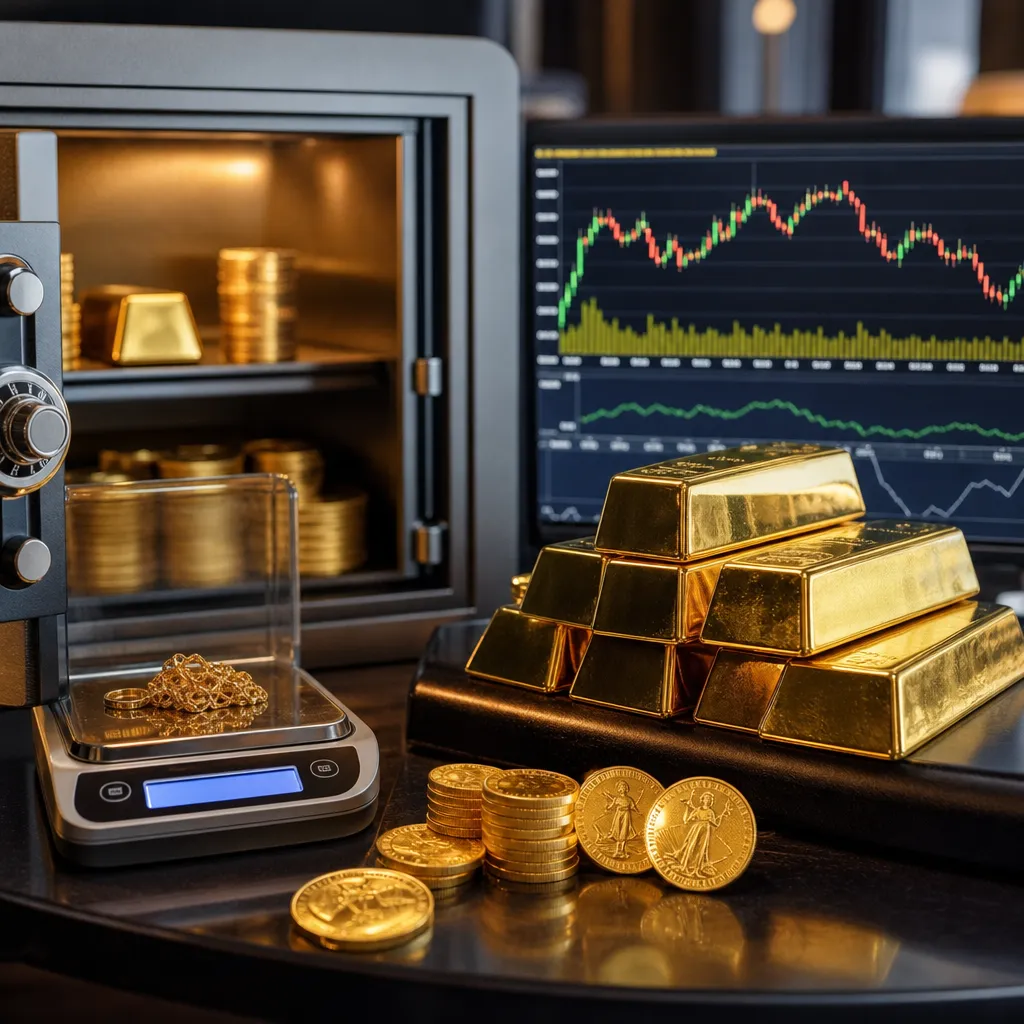
AI-based gold price forecasting means using machine learning models to analyze large sets of market, macroeconomic, and sentiment data in order to estimate the future direction of gold. For most readers, the important question is not whether AI can “predict” gold perfectly, but whether it can improve decision-making compared with simple charts, headlines, or one-factor narratives. The practical answer is yes—sometimes—but only when AI is used as a disciplined forecasting tool rather than a source of false certainty.
Gold is a difficult asset to model because it reacts to several forces at once: real yields, the US dollar, central bank demand, ETF flows, risk sentiment, inflation expectations, and geopolitical stress. An AI forecast can help organize these inputs and detect non-obvious relationships, but it still depends on data quality, model design, and changing market regimes. A useful gold price forecast using AI should therefore be understood as a probability framework, not a promise.
What an AI gold price forecast actually means
In practice, AI does not “know” where gold is going. It looks for patterns in historical data and tries to estimate how similar conditions may affect future prices. Depending on the design, a model may forecast short-term direction, volatility, trend strength, or broader scenario probabilities over weeks, months, or years.
For gold, AI models are usually more useful when they answer structured questions such as:
- Is the macro backdrop becoming more supportive or less supportive for gold?
- Are current market conditions similar to prior bullish, neutral, or bearish periods?
- Is momentum confirming fundamentals, or diverging from them?
- Has the relationship between gold and key drivers such as real yields or the dollar changed?
The table below shows the most common forecasting horizons and what AI can realistically contribute.
| Forecast horizon | What AI may help with | Main limitation |
|---|---|---|
| Intraday to a few days | Pattern recognition, volatility shifts, reaction to news and momentum | Very noisy data; sudden moves can overwhelm the model |
| 1 to 4 weeks | Short-term trend assessment, rate and dollar sensitivity, positioning shifts | Market sentiment can reverse quickly |
| 3 to 12 months | Macro regime analysis, real-yield trends, recession and policy expectations | Policy surprises and geopolitical shocks are hard to quantify |
| Multi-year outlook | Scenario building around inflation, reserve diversification, monetary regimes | Structural breaks make long-range forecasts highly uncertain |
The main takeaway is that AI is usually strongest at improving structured analysis, not at delivering exact future prices with confidence.
How AI models forecast gold prices
Most AI systems for gold forecasting combine several categories of inputs. Some models rely mostly on time-series price data. More advanced versions blend market data with macroeconomic variables and even text-based sentiment signals from news or central bank communication.
Common model inputs
- Gold market data: spot price, futures price, returns, volatility, trading volume, open interest
- Rates data: nominal Treasury yields, real yields, yield curve shape, policy expectations
- Currency data: US Dollar Index or broad dollar measures
- Inflation data: CPI, PCE, inflation expectations, breakevens
- Flows and positioning: ETF flows, futures positioning, risk appetite indicators
- Stress signals: equity volatility, credit spreads, banking stress, geopolitical risk proxies
- Physical demand proxies: jewelry demand trends, central bank buying, seasonal patterns where relevant
Common AI approaches
- Regression and boosted-tree models: often used to rank the importance of variables and forecast directional pressure
- Neural networks: useful for capturing nonlinear relationships, though sometimes less interpretable
- Sequence models: designed for time-series behavior, where the order of events matters
- Natural language processing: used to quantify tone in news, Fed statements, or market commentary
- Ensemble models: combine several model types to reduce dependence on one method
For professionals, the best systems rarely rely on one model alone. They often use an ensemble that combines macro factors, cross-asset behavior, and technical conditions.
The variables that matter most for AI-based gold forecasts
Gold does not respond to one driver in isolation. A strong AI forecast should treat the market as a system in which variables interact. For example, rising rates may pressure gold, but if inflation expectations rise faster than nominal yields, real yields may fall and support gold instead.
| Factor | Typical influence on gold | Why AI monitors it |
|---|---|---|
| Real yields | Often negative when rising, supportive when falling | Gold has no yield, so changing real return alternatives matter |
| US dollar | Often inverse, but not always | Gold is internationally priced in dollars; currency strength affects affordability and flows |
| Inflation expectations | Can support gold, especially if policy credibility weakens | Helps distinguish nominal inflation from real return dynamics |
| Monetary policy expectations | Easing expectations often supportive | Policy affects yields, liquidity, recession risks, and the dollar |
| Risk sentiment | Can support gold during stress | Captures safe-haven demand and portfolio reallocation |
| Central bank demand | Potentially supportive over time | Signals reserve diversification and steady official-sector demand |
| ETF and futures flows | Can amplify moves in both directions | Reflects investor positioning and momentum |
This is where AI can add real value. Instead of assuming that one variable always dominates, the model can estimate when a factor is becoming more or less important under current conditions.
Scenario-based gold price forecast using AI
A credible AI gold price forecast should present scenarios, not certainties. That is especially true for gold because regime shifts can quickly change the market narrative.
| Scenario | Conditions | Potential implication for gold |
|---|---|---|
| Bullish | Falling real yields, softer dollar, rising recession risk, sustained central bank demand, stronger safe-haven flows | Gold could remain well supported and potentially extend its uptrend |
| Base case | Mixed macro signals, stable or range-bound real yields, moderate dollar moves, steady but not extreme investment demand | Gold may trade unevenly, with macro headlines driving short-term swings |
| Bearish | Rising real yields, stronger dollar, resilient growth, reduced stress demand, weaker investor flows | Gold could face pressure, especially if opportunity costs rise materially |
The practical use of this framework is simple: AI can help estimate which scenario appears most consistent with current data, but it cannot eliminate uncertainty. Gold may still rally in a bearish-rate environment if geopolitical risk suddenly dominates, or fall in a bullish macro environment if investors raise cash broadly.
Where AI is genuinely useful for gold investors and traders
AI forecasting becomes useful when it improves process. It can help investors avoid simplistic conclusions such as “inflation is up, so gold must rise” or “rates are higher, so gold must fall.” Gold often reacts to the interaction between variables rather than any single headline.
For medium-term investors, AI is often best used to rank the balance of macro conditions. For traders, it can be more useful as a filter that confirms or rejects setups from technical analysis. For institutions, AI can be used in risk management, scenario testing, and dynamic portfolio allocation.
Practical applications
- Macro dashboarding: detect whether the gold backdrop is improving or deteriorating
- Signal weighting: compare the relative importance of real yields, dollar moves, and risk sentiment
- Trend confirmation: combine AI probabilities with support, resistance, and momentum tools
- Volatility forecasting: assess whether position size should be reduced or increased
- Scenario testing: estimate how gold may react if the Fed turns more dovish or if risk assets weaken sharply
Used this way, AI is less about replacing human judgment and more about reducing bias and improving consistency.
The biggest limitations of AI gold forecasts
The strongest criticism of AI forecasting is also the most important practical warning: gold’s behavior changes across regimes. A model trained on one environment may fail badly in another. Relationships that seemed stable can weaken, reverse, or disappear temporarily.
Several limitations matter in the real world:
- Regime shifts: the gold market during disinflation is not the same as during banking stress or reserve diversification
- Data lag: some macroeconomic inputs arrive slowly, while gold moves instantly
- Overfitting: a model may fit historical noise instead of durable relationships
- Interpretability: more complex models can become harder to trust or diagnose
- Shock events: wars, sanctions, liquidity squeezes, or surprise policy actions are difficult to model well
One of the most common mistakes is treating AI output as objective truth. In reality, every model reflects choices about data, time horizon, feature selection, and assumptions. Bad inputs can produce sophisticated-looking but weak forecasts.
How to evaluate an AI gold forecast critically
If you are reading an AI-based gold outlook, the first question should be: what exactly is being forecast? Direction over a week is very different from a 12-month macro outlook. The second question is whether the model explains its drivers or simply produces a target.
A practical checklist includes:
- Does the model use relevant macro variables, not just past gold prices?
- Does it distinguish nominal rates from real yields?
- Does it account for dollar strength and risk sentiment?
- Is the output scenario-based or falsely precise?
- Has the model been tested across different market regimes?
- Can the signal be combined with position sizing and risk management?
If an AI forecast gives a specific future gold price without explaining the conditions required for that outcome, it should be treated cautiously. Precision is not the same as accuracy.
What to watch now when using AI for gold price outlooks
Even without quoting live figures, the core monitoring framework is clear. Investors should track whether real yields are trending up or down, whether the dollar is strengthening or weakening, whether central banks remain active buyers, and whether recession or financial-stress risks are increasing.
It also helps to separate short-term noise from medium-term structure. Gold can sell off temporarily during a risk event if investors need liquidity, even when the broader environment later becomes supportive. AI models that blend market internals with macro trends can be helpful precisely because they force this distinction.
For most serious users, the best approach is to combine three layers:
- Macro layer: real yields, monetary policy, inflation expectations, dollar trend
- Flow layer: ETFs, futures positioning, central bank activity, risk appetite
- Market layer: price trend, volatility, support and resistance, breakout or mean-reversion behavior
That combination is usually more robust than relying on either AI alone or discretionary judgment alone.
FAQ
Can AI accurately predict gold prices?
AI can improve probability-based forecasting, but it cannot predict gold with certainty. It is best at identifying patterns, changing macro conditions, and relative scenario odds rather than exact future prices.
What data is most important in an AI gold price forecast?
Real yields, US dollar strength, inflation expectations, monetary policy expectations, risk sentiment, and investor flows are usually among the most important variables. Central bank demand can also matter, especially over longer horizons.
Is AI better than technical analysis for gold?
Not necessarily. AI and technical analysis often work better together. Technical analysis helps with timing and structure, while AI can help assess whether the broader macro and flow environment supports the trade.
Why do AI gold forecasts sometimes fail?
They fail when market relationships change, when the model is overfit to old data, when key variables are missing, or when sudden shocks dominate normal patterns. Gold is especially sensitive to regime changes and surprise events.
Should long-term investors use AI for gold decisions?
Yes, but as a framework rather than a decision-maker. For long-term investors, AI is most useful for scenario analysis and tracking whether the macro backdrop is becoming more or less favorable for gold.
Do rising interest rates always hurt gold in AI models?
No. What often matters more is the direction of real yields, not nominal rates alone. If inflation expectations rise faster than nominal yields, gold can remain supported despite higher headline rates.
Can AI include geopolitical risk in a gold forecast?
To some extent. Models can use volatility indices, news sentiment, and other stress proxies, but geopolitical shocks are difficult to quantify cleanly. This is one reason scenario analysis remains essential.
Sources
- World Gold Council – gold market research and Gold Demand Trends
- Federal Reserve Economic Data (FRED) – interest rate, yield, and macroeconomic data
- LBMA – gold market benchmark and pricing information