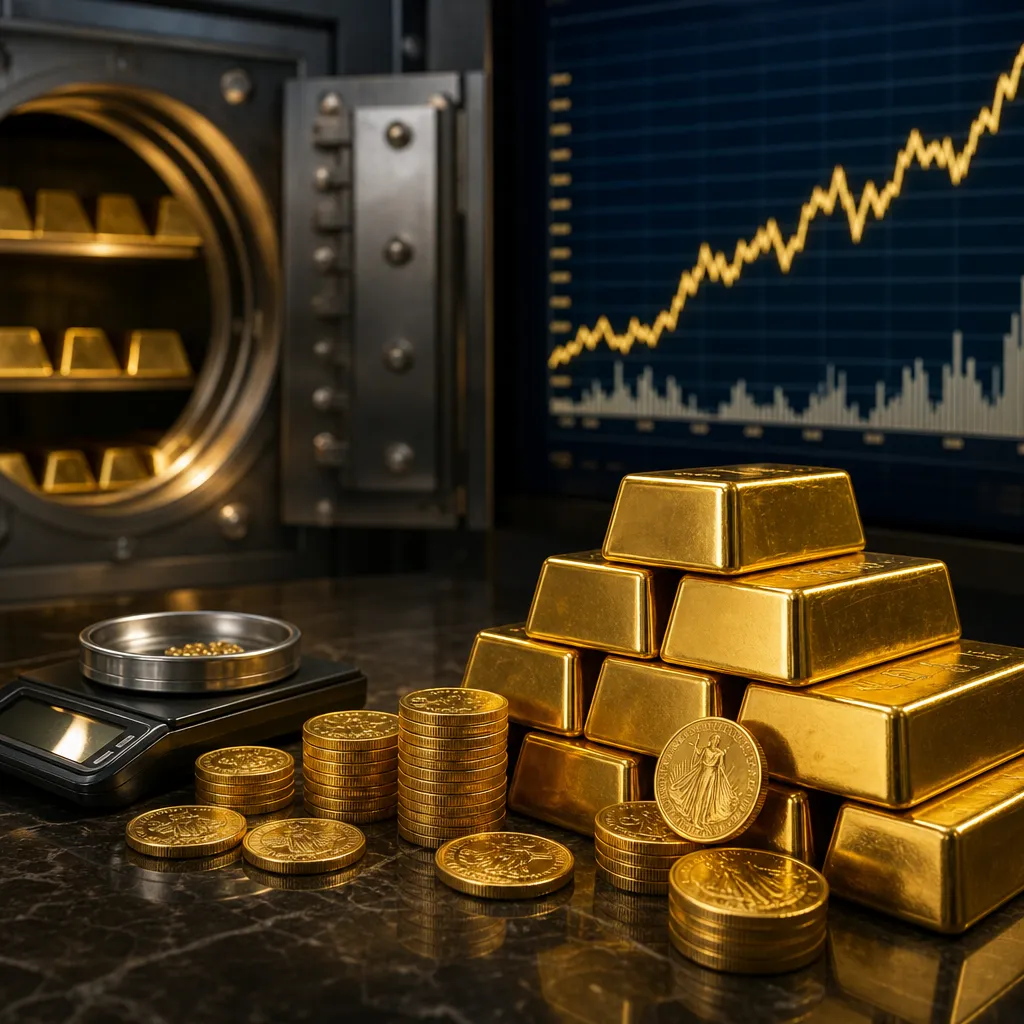
The gold price per ounce in INR is the value of one troy ounce of gold expressed in Indian rupees. For most readers, the key point is simple: this price is not driven only by global gold markets, but also by the USD/INR exchange rate, local premiums, product type, and purity. That is why the gold price you see quoted online can differ from the price of a coin, bar, or jewellery item in India. Understanding those layers helps you read the market more accurately and avoid confusing spot price with the actual retail price you may pay.
What “gold price per ounce in INR” actually means
Gold is traded internationally mainly in U.S. dollars per troy ounce. A troy ounce is a precious-metals unit equal to about 31.1035 grams, which is different from the everyday avoirdupois ounce used for general goods.
When people search for the gold price per ounce in INR, they usually want one of two things:
- The market value of one troy ounce of gold converted into Indian rupees
- A practical sense of what that means for buying gold in India
Those are related, but not identical. The first is a market reference price. The second includes real-world frictions such as dealer spreads, product premiums, logistics, and, in the case of jewellery, making charges and purity differences.
How the INR gold price is formed
The local gold price starts with the international benchmark and then passes through currency conversion and market-specific adjustments. In practice, the INR price can rise even if global gold is flat, simply because the rupee weakens against the U.S. dollar.
The table below shows the main building blocks.
| Component | Effect on gold price per ounce in INR | Why it matters |
|---|---|---|
| International gold price in USD | Primary driver | Global spot and futures markets set the base value of gold, usually quoted in dollars per troy ounce. |
| USD/INR exchange rate | Direct currency conversion effect | If the rupee weakens versus the dollar, gold becomes more expensive in INR even if the USD gold price is unchanged. |
| Wholesale and retail premiums | Raises local transaction price above spot | Premiums reflect fabrication, distribution, financing, inventory, and dealer margin. |
| Product type | Can widen the gap versus spot | Coins, bars, ETFs, and jewellery do not trade at the same effective price. |
| Purity | Changes value per unit of weight | 24K bullion and lower-purity jewellery should not be priced as if they contain the same amount of fine gold. |
| Taxes and import-related costs | Can increase local end price | Country-specific levies and import frictions can affect the retail price paid by buyers. |
The main takeaway is that gold in INR is a combination of a global commodity price and a currency price. This matters because Indian investors are exposed not only to gold itself, but also indirectly to rupee-dollar moves.
Why the INR gold price can move even when gold is “not moving” globally
A common source of confusion is seeing international headlines that gold was flat, while local prices in India still changed noticeably. The reason is that the benchmark is usually in USD.
If the dollar price of gold remains stable while the rupee depreciates, the INR gold price tends to rise. Conversely, if global gold rises but the rupee strengthens enough against the dollar, the local INR increase may be muted.
This creates a two-layer market dynamic:
- Gold market risk: whether the global gold price rises or falls
- Currency risk: whether the rupee strengthens or weakens versus the dollar
For Indian buyers and investors, both matter. Someone holding gold in INR is effectively tracking a dollar-priced asset translated into rupees.
Spot gold versus the price of physical gold in India
The quoted gold price per ounce in INR is usually closest to a wholesale or spot-equivalent reference. It is not automatically the same as the price of a minted bar, sovereign coin, or jewellery item in a retail shop.
The differences below are practical and important.
| Price type | What it represents | Usually lower or higher than spot-equivalent? | Practical significance |
|---|---|---|---|
| Spot-equivalent INR gold price | Market reference value of fine gold converted into rupees | Baseline reference | Useful for tracking the market, not necessarily the end purchase price. |
| Bullion bar price | Retail price for a physical bar | Usually higher | Includes fabrication, handling, distribution, and dealer spread. |
| Gold coin price | Retail price for minted investment coins | Often higher than bars | Coins may carry larger premiums because of minting and branding. |
| Jewellery price | Gold value plus non-gold commercial costs | Often much higher | Includes workmanship, design, retail margin, and purity differences. |
| Sell-back or scrap value | What a dealer or refiner may pay you | Usually lower | Buy-sell spreads, testing, and refining deductions affect resale value. |
The practical lesson is that a market quote is a benchmark, not a guaranteed transaction price. This distinction is especially important when comparing bullion investing with jewellery purchases.
How to convert gold from ounce pricing into grams used in India
India commonly discusses gold in grams and tolas, while global markets often use troy ounces. If you start from an ounce-based quote, the conversion is straightforward in principle.
1 troy ounce = 31.1035 grams
So, an approximate fine-gold value per gram can be derived by dividing the INR ounce price by 31.1035. But that gives you only the value of pure gold before product-specific costs. If the item is not 24K or 999/995 fine gold, you must also adjust for purity.
Purity matters when translating ounce price into item value
A 24K investment product is close to pure gold. Jewellery may be 22K, 18K, or another purity level, meaning not all of its weight is pure gold. That means two objects with the same gross weight can have different actual gold value.
- 24K: highest purity commonly used for bullion
- 22K: common in jewellery markets, but contains less fine gold than 24K
- 18K: lower fine-gold content, often used for durability and design
When a buyer confuses gross weight with fine-gold weight, pricing errors follow quickly.
What most influences the gold price per ounce in INR
Several variables can move gold in rupee terms, but some matter more consistently than others.
1. International gold price
This is the foundation. Global gold responds to factors such as real interest rates, the U.S. dollar, inflation expectations, central bank demand, ETF flows, risk sentiment, and geopolitical stress.
2. USD/INR exchange rate
This is the second major driver. Because gold is globally priced in dollars, the rupee exchange rate can amplify or offset moves in the underlying metal.
3. Real interest rates and bond yields
Gold does not generate income, so higher real yields can increase the opportunity cost of holding it. But the relationship is not mechanical. If yields rise because inflation fears are building or financial stress is increasing, gold may still hold up or rise.
4. Domestic demand conditions
Seasonal buying, wedding demand, festival demand, and investor appetite can affect local premiums even when the global benchmark is stable.
5. Market structure and product premiums
Retail conditions matter. Tight local supply, stronger investment demand, or higher distribution costs can widen premiums above international spot-equivalent pricing.
Why Indian investors often monitor both gold and the rupee
For an investor based in India, gold can serve more than one role. It may act as exposure to the precious metal itself, but it can also function as a partial hedge against rupee weakness, depending on the instrument used and the portfolio context.
This is one reason local-currency gold can sometimes perform differently from USD gold. A period that looks mediocre in dollar terms may appear stronger in INR if the rupee has depreciated.
That does not make gold a guaranteed currency hedge. The relationship varies over time, and local gold prices can still decline if the global drop in gold is large enough or if the rupee strengthens materially.
What to pay attention to before buying gold in INR
If your interest is practical rather than purely analytical, focus on the actual transaction structure rather than just the headline ounce quote.
- Check the unit: ounce, gram, and tola are not interchangeable.
- Check purity: 24K bullion and 22K jewellery are different products.
- Separate spot from retail: the quoted market price is usually not the final invoice price.
- Understand the spread: what you can sell for may be meaningfully lower than what you paid.
- Know the product: bars, coins, ETFs, and jewellery serve different purposes.
- Consider storage and authenticity: physical ownership introduces custody and verification issues.
For jewellery buyers, the most common mistake is assuming the gold content alone explains the retail price. In reality, design, wastage assumptions, making charges, branding, and resale conditions can all matter.
Key limitations of using the ounce price alone
The gold price per ounce in INR is useful, but it has limits. It is best seen as a benchmark for market direction rather than a complete quote for every real-world purchase.
It does not tell you:
- the exact price of a specific retail product
- the resale value of jewellery
- the premium on branded coins or small bars
- the effect of purity differences on a specific item
- the local buy-sell spread you will face
It also does not remove timing risk. Gold can be volatile, and local-currency performance may be shaped as much by the exchange rate as by the metal itself.
FAQ
Why is the gold price per ounce in INR different from the international gold price?
The international gold price is usually quoted in U.S. dollars per troy ounce. The INR price adds currency conversion through USD/INR and may also reflect local premiums, taxes, import-related costs, and product-specific markups.
Does a weaker rupee always make gold more expensive in India?
All else equal, a weaker rupee tends to lift the gold price in INR because gold is globally priced in dollars. However, if the international gold price falls sharply enough, that decline can offset the currency effect.
Is the gold price per ounce in INR the same as the price I will pay for jewellery?
No. Jewellery pricing usually includes lower purity than pure bullion, plus making charges, design costs, retail margin, and other commercial additions. The ounce quote is only a benchmark for the underlying metal value.
How do I convert ounce price into gram price?
Divide the INR price per troy ounce by 31.1035 to get the approximate value per gram of pure gold. Then adjust for purity if the item is not 24K or fine bullion.
What matters more for local gold prices in India: gold itself or the exchange rate?
Both matter. The underlying global gold price is the base driver, while the USD/INR exchange rate determines how that price translates into rupees. In some periods, currency moves explain a large share of local price changes.
Why is physical gold more expensive than the quoted market price?
Physical products include costs that spot gold does not: fabrication, transportation, storage, insurance, dealer margin, and bid-ask spread. Coins often carry higher premiums than larger bars.
Is ounce pricing useful if gold is commonly sold in grams in India?
Yes. Ounce pricing is useful because it connects the local market to the global benchmark. Even if consumers buy in grams, the international ounce quote helps explain the direction of the market and the effect of currency conversion.
Sources
- LBMA – gold price benchmark and precious metals market information
- CME Group – gold futures market and contract information
- World Gold Council – gold market research and India gold market analysis