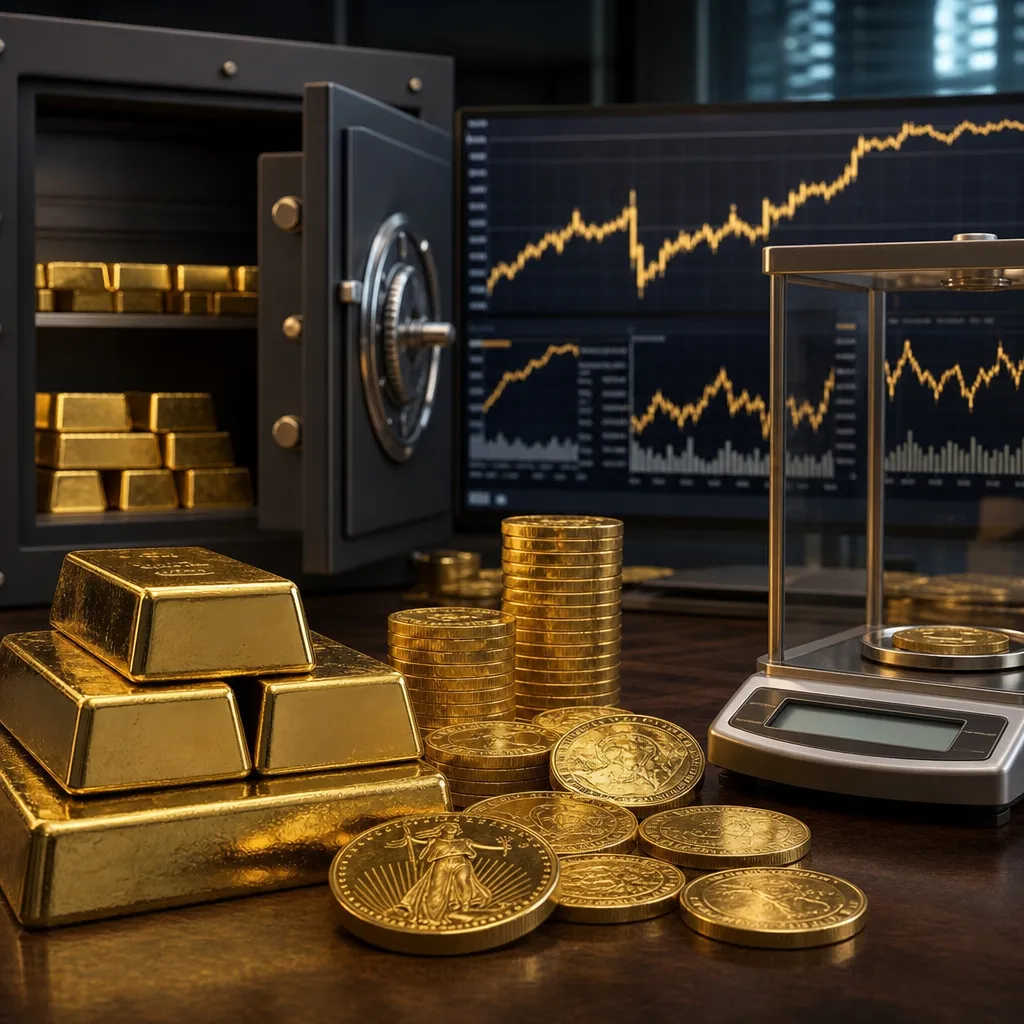
Gold price and physical demand are closely related, but not in the simple way many people assume. Physical demand includes jewelry buying, investment bars and coins, central bank purchases, and in some contexts industrial use. It matters because strong buying of real metal can tighten markets, influence premiums, and support sentiment, yet the global gold price is also shaped by futures markets, interest rates, the US dollar, ETF flows, and macroeconomic expectations.
For most readers, the key point is this: physical demand can support gold prices, especially when it is broad and persistent, but it is only one driver among several. At times, heavy physical buying coincides with rising prices; at other times, prices fall even while coin and bar demand improves. Understanding why requires separating wholesale price formation from retail physical markets.
What “physical demand” means in the gold market
Physical demand refers to demand for actual gold metal rather than paper exposure. That includes wholesale bars, retail bullion products, jewelry fabrication, and official-sector purchases by central banks. The category is broad, and each segment behaves differently.
Jewelry demand is often sensitive to local incomes, cultural buying seasons, and price levels. Bar and coin demand is more investment-driven and often rises when households want protection from inflation, currency weakness, banking stress, or geopolitical risk. Central bank demand is usually strategic rather than speculative.
The table below shows the main components of physical demand and how they tend to behave.
| Physical demand segment | What it includes | Typical driver | Practical relevance for price |
|---|---|---|---|
| Jewelry demand | Necklaces, rings, bracelets, fabricated products | Income, culture, seasonality, local prices | Large in volume, but sometimes price-sensitive and slower-moving |
| Bar and coin demand | Retail bullion bars and investment coins | Wealth preservation, inflation fears, crisis demand | Important for sentiment and retail market tightness |
| Central bank demand | Official reserve purchases | Reserve diversification, geopolitical risk, currency strategy | Can provide structural support over longer periods |
| Industrial and technology demand | Electronics and specialist applications | Manufacturing activity and industrial need | Usually less important than investment and jewelry demand |
The main takeaway is that “physical demand” is not one thing. A surge in coin demand does not necessarily mean jewelry demand is strong, and official-sector buying can remain firm even when retail investors are quiet.
How the gold price is actually formed
The international gold price is usually discussed as a spot or near-spot price, but actual price discovery is heavily influenced by large wholesale and derivatives markets, particularly LBMA trading and COMEX futures. These markets are far more liquid than the retail coin and small-bar market.
That is why retail physical buying does not automatically set the global gold price minute by minute. If futures traders aggressively price in higher real yields or a stronger US dollar, gold can fall even if coin shops are busy. Conversely, prices can rise sharply on macro drivers before retail bar and coin demand fully reacts.
Physical demand still matters because it affects whether lower prices attract buyers, whether premiums rise, and whether wholesale metal is absorbed rather than recycled back into the market.
Why physical demand can support gold prices
Physical demand matters most when it is persistent, broad-based, and strong enough to absorb available supply. This can happen through high jewelry consumption in major markets, robust bar and coin buying during financial stress, or sustained central bank accumulation.
There are several mechanisms through which this support works:
- Absorption of supply: more metal moves into long-term hands instead of returning quickly to the market.
- Higher premiums: strong retail demand can push coin and bar prices above spot, signaling local tightness.
- Sentiment reinforcement: visible buying from households or central banks can strengthen the market narrative.
- Price floor behavior: lower prices may trigger bargain buying, especially in price-sensitive physical markets.
This does not mean every uptick in demand creates a rally. What matters is whether physical buying is strong enough to offset other forces, especially changes in real yields, the dollar, and investment flows.
When physical demand does not lift the gold price
One of the most important limitations is that physical demand can be strong while gold still struggles. That usually happens when macro forces are working in the opposite direction.
For example, if real interest rates rise sharply, investors may prefer interest-bearing assets over a non-yielding asset like gold. If the US dollar strengthens, gold can become more expensive in other currencies, reducing some international buying power. Large ETF outflows can also outweigh steady physical buying.
The relationship is best understood as conditional rather than automatic.
| Market condition | Typical effect on physical demand | Possible effect on gold price | Important caveat |
|---|---|---|---|
| Sharp price decline | Often boosts bargain buying in bars, coins, and jewelry | May stabilize price | Not enough if macro selling remains heavy |
| Rising real yields | Physical buyers may still emerge | Often pressures gold | Safe-haven demand can offset this during crises |
| Stronger US dollar | Can weaken some non-dollar demand | Often negative for gold | Local-currency fear can still support demand in some countries |
| Financial stress or banking fears | Can lift bar and coin demand significantly | Often supportive | Short-term liquidity events can still trigger temporary selling |
| Central bank accumulation | Steady official demand for physical metal | Can support longer-term price structure | Usually does not explain every short-term move |
The practical lesson is simple: physical demand often helps most at turning points and on medium-term support, while short-term price moves are frequently dominated by financial markets.
Which forms of physical demand matter most
Not all physical demand has the same market impact. Retail bars and coins are highly visible and often discussed in headlines, but central bank purchases and jewelry demand can be larger in strategic importance depending on the period.
Jewelry demand
Jewelry is a major source of physical consumption, especially in key consumer markets. However, it is often price-sensitive. When gold becomes too expensive in local currency terms, buyers may reduce volumes, shift to lighter items, or delay purchases.
Bars and coins
Investment bullion demand tends to be more reactive to fear, inflation concerns, and distrust of financial assets. It can surge during banking stress or currency weakness. This segment is particularly important for retail investors because it directly affects product availability and dealer premiums.
Central banks
Central banks generally buy for reserve diversification, risk management, and long-term strategic reasons. Their purchases are often less sensitive to short-term price moves than household buying. Because they can be large and persistent buyers, their demand can matter more to the long-term backdrop than to daily volatility.
Physical demand, premiums, and the difference between spot and retail price
Many people see strong physical demand and expect the quoted gold price to jump. Sometimes what moves first is not spot gold, but the premium paid above spot for coins and bars.
Retail physical products include fabrication, minting, transport, insurance, dealer margins, and local taxes where applicable. During periods of intense demand or supply disruption, these premiums can widen sharply even if the international gold price is relatively stable.
That is why “gold demand is strong” can mean two different things:
- the global market is absorbing large quantities of bullion, which may support the broader price trend, or
- the retail market is tight, which may mainly show up in higher product premiums and lower local availability.
For investors buying physical gold, this distinction is crucial. A strong physical market can make it more expensive to enter and can also affect resale spreads.
How supply interacts with physical demand
Gold is unusual because most of the metal ever mined still exists in some form. That means supply is not just new mine output. It also includes recycled gold, central bank activity, and the willingness of existing holders to sell.
When prices rise, recycling often increases because jewelry owners and scrap sellers are more willing to sell. That can partially offset strong physical demand. When prices fall, recycling may slow while bargain buying strengthens, helping the market find support.
Mine supply tends to change more slowly. It usually does not explain short-term price moves, but it matters over longer cycles, especially when combined with changes in investment demand and official-sector buying.
What investors should watch if they care about physical demand
If you want to understand whether physical demand is likely to matter for gold price direction, watch a combination of physical and financial indicators rather than just one headline.
- Central bank buying trends: important for long-term structural demand.
- Bar and coin demand: useful for reading retail investor anxiety or confidence.
- Jewelry demand in major consumer markets: relevant for broad consumption trends.
- ETF flows: important because financial investment flows can overpower retail bullion demand.
- Real yields: one of the most influential macro variables for gold.
- US dollar direction: often important for international pricing and purchasing power.
- Retail premiums and availability: good indicators of stress or tightness in physical channels.
In practice, the most bullish setup for gold usually involves a combination of supportive macro conditions and healthy physical demand. Physical buying alone can help, but it tends to be most powerful when it aligns with falling real yields, a softer dollar, or rising safe-haven demand.
Risks and common misunderstandings
A common mistake is to assume that any increase in physical demand guarantees a higher gold price. The gold market is global, deep, and influenced by many layers of trading and investment behavior. Physical demand is important, but it does not operate in isolation.
Another misunderstanding is to focus only on retail shortages. A local shortage of certain coins or small bars does not necessarily mean there is a global shortage of wholesale gold. It may reflect bottlenecks in fabrication, distribution, or mint capacity.
It is also important to separate price support from immediate price direction. Physical demand often contributes more to underlying support and resilience than to every daily move on the chart.
FAQ
Does strong physical demand always push gold prices higher?
No. Strong physical demand can support gold, but prices are also driven by futures markets, ETF flows, real yields, the US dollar, and risk sentiment. If those forces are strongly negative, gold can still fall even when physical buying is firm.
Why can gold coins and bars become expensive even if spot gold is flat?
Because retail prices include premiums above spot. Those premiums reflect fabrication, transport, dealer margins, and market tightness. In periods of heavy retail demand, premiums can rise sharply without a matching move in the benchmark gold price.
What type of physical demand matters most for the gold market?
It depends on the time frame. Central bank buying can matter greatly for long-term support. Bar and coin demand is important during stress periods. Jewelry demand is large in volume, but it is often more price-sensitive.
Can physical demand create a floor under gold prices?
Often, yes. Lower prices can attract bargain buyers in jewelry and bullion markets, which may help stabilize the market. But it is not a guaranteed floor if macro selling pressure is severe.
How do central bank purchases affect gold prices?
Central bank buying can strengthen long-term demand by removing metal from the market for reserve purposes. It may support sentiment and supply-demand balance, but it usually does not explain every short-term fluctuation.
Is ETF demand more important than physical bullion demand?
For short-term market moves, ETF flows can sometimes be more influential because they reflect large financial allocations. Physical bullion demand is still very important, especially for market support, but financial flows can dominate for periods of time.
What should I monitor if I want to judge whether physical demand is truly bullish?
Look for broad confirmation: steady central bank buying, healthy bar and coin demand, resilient jewelry demand, manageable recycling supply, and a macro backdrop that is not strongly hostile to gold, especially in terms of real yields and the dollar.
Sources
- World Gold Council – gold market supply, demand, and central bank research
- LBMA – gold market and benchmark pricing information
- CME Group – gold futures market and contract information