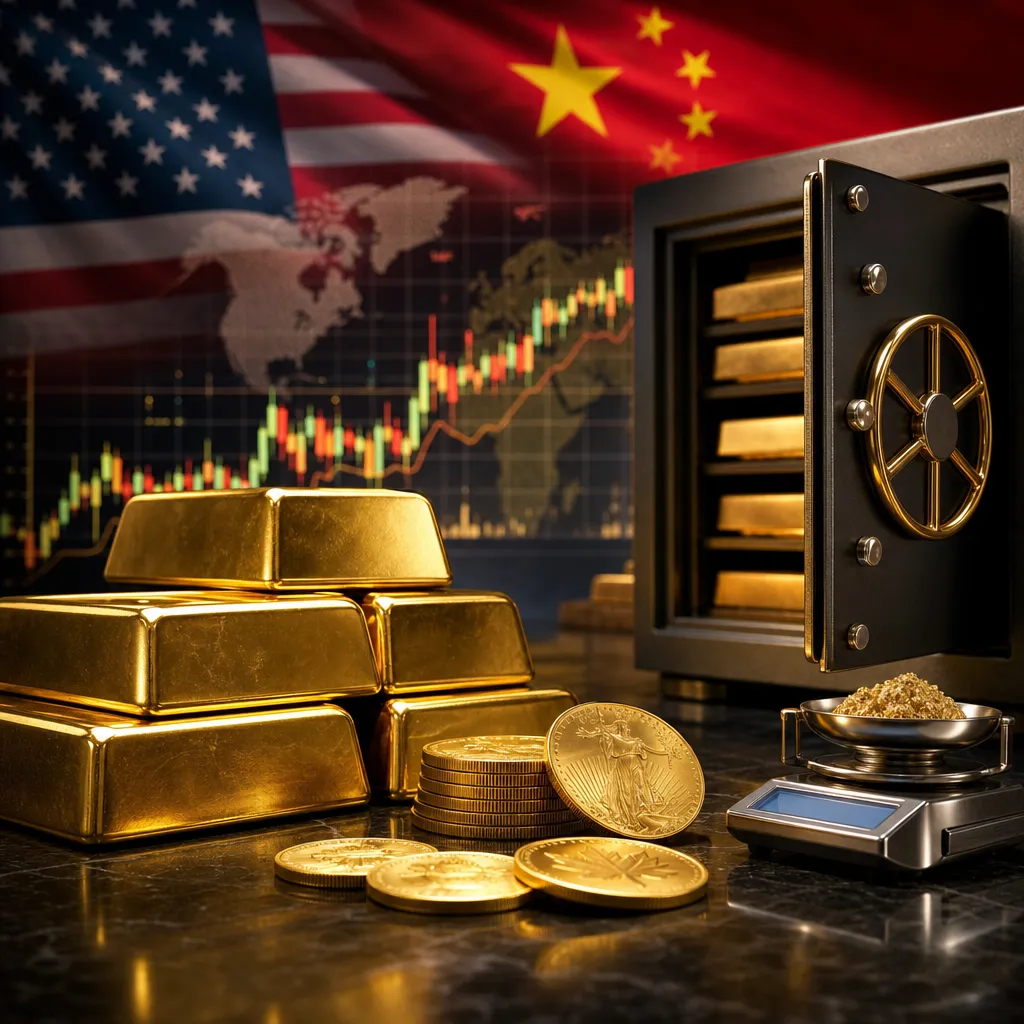
US-China tensions can matter for the gold price, but not in a simple “bad news equals higher gold” way. The core relationship is that rising geopolitical stress between the world’s two largest economies can increase demand for safe-haven assets, shift expectations for growth and interest rates, and move currencies such as the US dollar and Chinese yuan. Gold often reacts to that mix rather than to headlines alone. For investors and traders, the practical question is not just whether tensions are rising, but which channel is dominating: fear, dollar strength, bond yields, central bank behavior, or growth concerns.
Why US-China tensions affect gold
When markets worry about conflict between the United States and China, they are usually reacting to one or more of these issues: trade restrictions, technology bans, sanctions risk, Taiwan-related military tension, supply-chain disruption, capital-market restrictions, or broader strategic rivalry. Gold enters the picture because it is widely used as a defensive asset when confidence in growth, financial stability, or international cooperation weakens.
That said, gold does not respond to geopolitics in isolation. A serious deterioration in US-China relations might boost gold because investors want protection. But the same event could also strengthen the US dollar or push real yields higher, which can offset or even temporarily outweigh the safe-haven impulse.
The main transmission channels from US-China tensions to the gold price
The most useful way to understand the gold price during US-China stress is to break it into mechanisms rather than headlines.
| Transmission channel | Typical effect on gold | Why it matters |
|---|---|---|
| Safe-haven demand | Often supportive | Investors may move toward defensive assets when geopolitical or economic uncertainty rises. |
| US dollar strength | Often negative for gold | Gold is commonly priced in dollars, so a stronger dollar can make gold more expensive for non-dollar buyers. |
| Real yields | Often negative if rising | Higher inflation-adjusted yields increase the opportunity cost of holding a non-yielding asset such as gold. |
| Global growth fears | Can be supportive | Weaker growth expectations can increase recession hedging and raise expectations of easier monetary policy. |
| Central bank reserve diversification | Potentially supportive | Fragmentation in the global system can strengthen the case for holding reserve assets outside another country’s liabilities. |
| Liquidity stress | Mixed | In sharp market selloffs, investors may sell gold temporarily to raise cash even if the longer-term backdrop is supportive. |
The key takeaway is that gold reacts to the balance of these forces. In a mild diplomatic dispute, gold may barely move. In a severe escalation that hits growth expectations and risk appetite, the move can be much larger.
Why the relationship is not always straightforward
Many readers expect gold to rise automatically whenever US-China tensions worsen. Sometimes it does. Sometimes it does not. The main reason is that gold sits at the intersection of macroeconomics and risk sentiment.
For example, if tensions trigger a flight to safety, investors may buy both gold and US Treasuries, pushing bond yields lower and helping gold. But if the same event mainly boosts the US dollar, gold may struggle in dollar terms even while still rising in other currencies. Likewise, if markets think the shock is inflationary because it disrupts trade and supply chains, gold may benefit. If they think it is disinflationary because it damages demand and growth, the market response may depend more on central bank expectations.
This is why two episodes with similar headlines can produce different gold-price outcomes.
Which types of US-China tension matter most for gold
Not every form of rivalry has the same impact. Markets usually react more strongly when tensions threaten capital flows, supply chains, military stability, or the international monetary system.
| Type of tension | Potential relevance for gold | What to watch |
|---|---|---|
| Tariffs and trade disputes | Moderate | Growth expectations, inflation effects, and whether the dispute appears temporary or structural. |
| Technology restrictions | Moderate to high | Impact on semiconductor supply chains, corporate earnings, and long-term strategic decoupling. |
| Sanctions or financial restrictions | High | Cross-border settlement risk, reserve management implications, and concerns about asset seizure or payment-system access. |
| Taiwan-related military escalation | Very high | Risk sentiment, shipping routes, equity volatility, oil spillovers, and broad safe-haven demand. |
| Currency tension or FX intervention concerns | Moderate | US dollar strength, yuan weakness, and local-currency gold demand in Asia. |
| Long-term economic decoupling | High over time | Reserve diversification, fragmentation of trade patterns, and reduced confidence in a stable global order. |
Short-term traders tend to focus on military or sanctions-related escalation. Long-term investors may care more about structural decoupling and reserve diversification.
The role of the US dollar, yields, and Federal Reserve expectations
If you want to explain most major gold moves during geopolitical stress, three variables usually matter more than the headline itself: the US dollar, real yields, and expected Federal Reserve policy.
A sudden escalation in US-China tensions can lead to a stronger dollar if global investors seek liquidity and safety in dollar assets. That can cap or reverse gains in gold priced in dollars. On the other hand, if tensions increase recession fears and markets begin to expect lower policy rates or falling real yields, gold can strengthen meaningfully.
This is especially important because gold is a non-yielding asset. Investors compare it not only with risky assets, but also with inflation-adjusted returns on cash and government bonds. If those real returns are becoming more attractive, gold faces a headwind. If they are falling, gold often becomes more appealing.
In practice, a strong gold rally during US-China stress is more likely when:
- real yields are falling or expected to fall,
- the dollar is stable or weakening,
- equity volatility is rising,
- the market sees broader geopolitical or financial-system implications.
How China itself can matter for physical and official-sector gold demand
China matters to gold not only as one side of a geopolitical rivalry, but also as a major source of demand and an important official actor in the global monetary system. If US-China tensions contribute to concerns about sanctions, reserve security, or overdependence on any one currency system, central banks may view gold more favorably as a neutral reserve asset.
At the same time, Chinese consumer demand for jewelry, bars, and coins can also influence the market, especially when domestic investors want protection against currency weakness, property-market stress, or broader uncertainty. This does not mean every period of tension produces stronger Chinese demand, but it is one of the channels worth monitoring.
For gold investors, the practical point is that US-China conflict is not just a Western financial-market story. It can shape both investment demand and reserve behavior.
When gold can fall even as US-China tensions rise
This is one of the most misunderstood parts of the relationship. Gold can decline during geopolitical stress for several reasons.
- Dollar squeeze: if investors urgently want dollars, the US currency may rally enough to pressure gold.
- Rising real yields: if inflation expectations fall faster than nominal yields, real yields can rise and weigh on gold.
- Forced selling: during broader market stress, investors may sell liquid assets including gold to cover losses elsewhere.
- Headline fatigue: markets may stop reacting if tensions are recurring but not clearly escalating.
- Better risk appetite elsewhere: if investors conclude the event is manageable, they may rotate back into equities and cyclical assets.
That is why using geopolitical news alone as a gold trading signal can be unreliable.
What investors and traders should monitor
Instead of reacting to every headline, it is better to build a checklist. Gold tends to respond most clearly when geopolitical deterioration aligns with broader macro support.
| What to monitor | Why it matters for gold | Practical interpretation |
|---|---|---|
| US dollar direction | Gold often struggles when the dollar surges | If tensions lift the dollar sharply, gold upside may be limited in USD terms. |
| Real Treasury yields | Opportunity cost of holding gold | Falling real yields are generally more supportive than rising real yields. |
| Equity volatility | Measures risk aversion | A stronger defensive bid often appears when volatility rises materially. |
| Fed policy expectations | Shapes yields and the dollar | If tensions increase easing expectations, gold may gain support. |
| Energy and supply-chain stress | Affects inflation and growth expectations | Stagflation-like conditions can be constructive for gold. |
| Central bank reserve trends | Signals long-term official demand | Reserve diversification themes can support gold beyond short-term headlines. |
The main takeaway is that US-China tensions matter most when they become macro-relevant, not just politically prominent.
Implications for different types of gold exposure
The way you express a view on gold matters. Physical bullion, gold ETFs, futures, and mining stocks can all react differently to the same geopolitical event.
Physical gold and bullion-backed ETFs usually track the metal most directly. Futures can magnify short-term price swings and are more sensitive to positioning and liquidity. Gold mining stocks add company-specific and equity-market risk, so they may underperform the metal during broad market selloffs even if the long-term gold case improves.
If the thesis is specifically about a geopolitical hedge against US-China escalation, it is worth remembering that miners are not the same thing as gold itself.
Bottom line: how strong is the link?
US-China tensions are a real and important driver of the gold price, but they are best understood as a conditional catalyst rather than a guaranteed bullish trigger. Gold tends to respond positively when tensions increase safe-haven demand, weaken confidence in global growth, encourage reserve diversification, or push real yields lower. The relationship weakens when the dominant effect is a stronger dollar, higher real yields, or temporary liquidity stress.
For practical analysis, ask three questions. Is the event serious enough to affect growth or financial stability? Is it pushing the market toward lower real yields or just toward a stronger dollar? And is the reaction broad enough to influence official demand, ETF flows, or wider portfolio hedging behavior? Those questions usually matter more than the headline itself.
FAQ
Does gold always rise when US-China tensions increase?
No. Gold often benefits from rising geopolitical stress, but not always. A stronger US dollar, rising real yields, or forced liquidation can offset safe-haven demand.
Why can the US dollar rise at the same time as geopolitical risk?
In periods of stress, investors often seek liquidity and perceived safety in dollar assets, especially US Treasuries. Because gold is usually priced in dollars, dollar strength can create a headwind for gold in USD terms.
Are trade wars and military tensions equally important for gold?
Usually not. Markets tend to react more strongly to military escalation, sanctions risk, or threats to financial stability than to routine trade friction. Trade disputes can still matter, especially if they affect inflation, growth, or global supply chains.
How do real yields affect gold during geopolitical stress?
Real yields measure inflation-adjusted returns on interest-bearing assets. If real yields fall because investors expect weaker growth or easier monetary policy, gold often benefits. If real yields rise, gold can struggle even during tense geopolitical periods.
Can central bank buying make gold more resilient during geopolitical fragmentation?
Yes, potentially. If countries want to diversify reserves away from heavy dependence on another country’s currency or financial system, gold can become more attractive as a neutral reserve asset. That does not guarantee price gains, but it can add structural support.
Is gold a better geopolitical hedge than gold mining stocks?
For direct exposure to the metal, usually yes. Mining stocks carry operational, management, cost, and broader equity-market risks. They may provide leverage to gold over time, but they are not a pure safe-haven substitute for bullion.
What matters more for gold: the headline or the market reaction?
The market reaction matters more. The same headline can lead to very different gold outcomes depending on how it changes the dollar, bond yields, real yields, volatility, and growth expectations.
Sources
- World Gold Council – gold market research and analysis
- Federal Reserve Economic Data (FRED) – US dollar, yields, and macroeconomic data
- International Monetary Fund – reserve assets and international financial system research