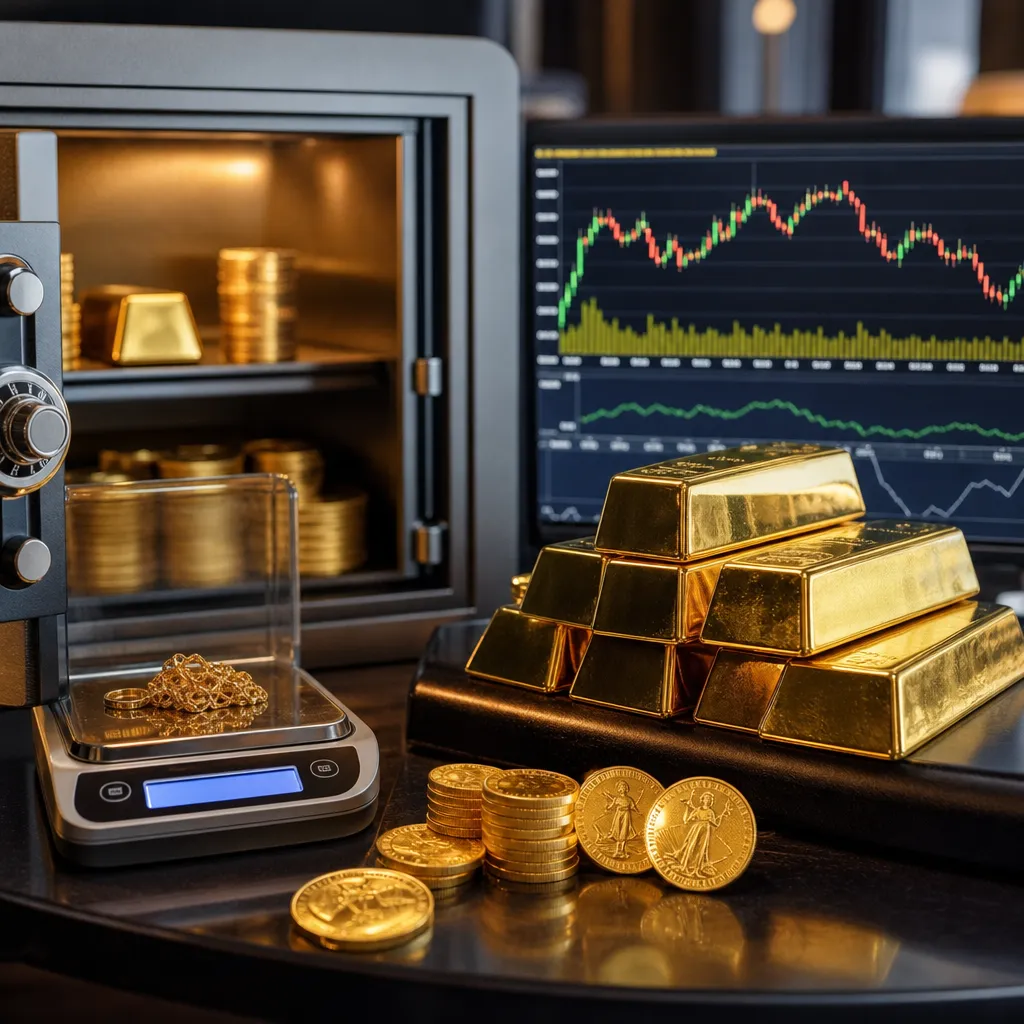
“Spot gold” and the “physical gold price” are related, but they are not the same thing. Spot gold is the benchmark market price for unallocated gold in the wholesale market, usually quoted per troy ounce in U.S. dollars. The price you actually pay for a coin or bar includes that spot price plus premiums, spreads, fabrication, distribution, storage, and dealer costs.
This difference matters because many investors see a live gold quote and assume they can buy bullion at that exact level. In practice, retail buyers almost always pay more than spot when purchasing physical gold and receive less than spot when selling it back. Understanding why that gap exists helps you compare dealers properly, choose between bars and coins, and avoid unrealistic expectations about liquidity and resale value.
If you remember one point, make it this: spot gold is a reference price; physical gold is a delivered product with real-world costs and market frictions.
What spot gold means
Spot gold refers to the current market price for immediate settlement of gold in the professional market. It is a benchmark used across trading desks, bullion banks, refiners, miners, ETF providers, and dealers. Although people often call it the “gold price,” it is not the same as the final retail checkout price for a gold coin or bar.
In market practice, spot pricing is linked to highly liquid wholesale trading venues and benchmark structures associated with the London bullion market and futures markets such as COMEX. Arbitrage between these markets helps keep prices aligned, even though they are not identical at every moment.
| Term | What It Represents | Who Uses It | Practical Importance |
|---|---|---|---|
| Spot gold | Benchmark wholesale price for near-immediate gold settlement | Traders, bullion banks, dealers, ETF market participants | Reference point for valuing gold globally |
| Physical gold price | Retail or wholesale delivered price for coins, bars, or other bullion products | Investors, collectors, dealers | What buyers actually pay and sellers actually receive |
| Bid price | Price a buyer or dealer is willing to pay | Dealers, traders | Relevant when selling gold |
| Ask price | Price at which a seller offers gold | Dealers, traders | Relevant when buying gold |
| Premium | Amount above spot for a physical product | Dealers, investors | Reflects fabrication, distribution, demand, and margins |
The key takeaway is that spot gold is the starting point for pricing physical bullion, not the finished transaction price.
What the physical gold price includes
Physical gold is not just metal in theory; it is a manufactured, transported, insured, stored, and distributed product. A one-ounce bar or sovereign mint coin must be refined, cast or minted, packaged, shipped, financed by inventory holders, and sold through a business that needs a margin.
That is why physical gold usually trades at a premium to spot. The premium can be modest for larger investment bars in normal market conditions, and noticeably higher for small bars, widely recognized bullion coins, or products in periods of heavy retail demand.
| Component | Usually Pushes Physical Price | Why It Exists |
|---|---|---|
| Spot gold price | Higher or lower with market moves | Base value of the fine gold content |
| Fabrication cost | Above spot | Refining, minting, casting, assaying, packaging |
| Dealer spread | Above buy price / below sellback price | Dealer compensation for market-making and inventory risk |
| Distribution and shipping | Above spot | Transport, insurance, logistics, handling |
| Product demand | Can widen premium | Popular coins and shortages can make buyers pay more |
| Storage and financing | Can widen premium | Holding inventory ties up capital and creates carrying costs |
For investors, this means the “all-in” acquisition cost matters more than the headline gold quote. Two products with the same gold weight can have meaningfully different buy and sell economics.
Why physical gold is usually more expensive than spot
The simplest reason is that spot gold is an institutional benchmark, while physical bullion is a retail or wholesale product. Premiums compensate the supply chain for turning raw metal exposure into a deliverable item.
Fabrication and product form
A kilo bar intended for the professional market is not the same product as a one-ounce minted bullion coin sold to retail buyers. Smaller products are more expensive to make on a per-ounce basis. Coins also often carry higher premiums than plain bars because minting, branding, and retail demand are stronger.
Dealer inventory and market risk
Dealers hold stock while the gold price changes constantly. Their spread helps cover that risk, along with operating costs and the possibility that they must hedge inventory exposure.
Retail surges and shortages
During financial stress, geopolitical shock, or sudden retail buying waves, physical premiums can detach from normal levels. In those periods, the benchmark spot price may not fully reflect what small investors need to pay for immediate access to coins and bars.
Why you usually sell below spot
Many first-time buyers focus only on the premium above spot when buying, but the resale side is just as important. Dealers generally buy back at a discount to their own resale price, and sometimes below spot depending on the product, quantity, condition, and market conditions.
This is normal market structure, not necessarily a warning sign. A dealer needs room between buy and sell prices to cover testing, handling, inventory, and market risk. Highly recognized products in good condition usually achieve better resale terms than obscure or damaged items.
The practical lesson is straightforward: physical gold is best understood as a medium- to long-term holding, not a frictionless trading instrument.
How spot and physical prices stay connected
Even though the two prices differ, they do not move independently for long. If spot rises sharply, physical bullion prices usually rise as well because the metal value inside the product has increased. If retail premiums become excessive relative to underlying market conditions, competition and arbitrage within the bullion chain may eventually narrow them.
The connection works through several channels:
- Dealer repricing: bullion sellers update offers as the benchmark market moves.
- Hedging: dealers and fabricators may hedge exposure in futures or wholesale markets.
- Arbitrage: large market participants react when price gaps become economically meaningful.
- Refining and mint supply: higher production and distribution capacity can reduce bottlenecks over time.
Still, “connected” does not mean “identical.” Small bars and coins can remain expensive relative to spot for extended periods when supply chains are tight.
When the gap between spot and physical gets wider
The spread between spot gold and physical gold prices is not fixed. It tends to widen under stress, especially when retail investors want immediate delivery of familiar products.
| Market Condition | Typical Effect on Physical Premiums | Mechanism |
|---|---|---|
| Strong retail demand | Premiums often rise | Dealers sell inventory faster and replacement stock becomes harder to source |
| Supply-chain disruption | Premiums often rise | Refining, minting, shipping, or import bottlenecks increase costs and scarcity |
| Preference for small products | Premiums often higher than large bars | Fabrication and distribution costs are larger per ounce |
| Calm, liquid market | Premiums often narrow | Inventory is easier to replace and competition is stronger |
| Highly recognizable bullion products | Premiums can stay elevated | Brand trust and resale liquidity support stronger pricing |
The main takeaway is that premiums are partly a reflection of logistics and market access, not just metal value.
Spot gold vs physical gold for different types of investors
The right reference price depends on what you are trying to do. A trader watching intraday gold moves cares mainly about spot and futures behavior. A long-term bullion buyer should care more about total acquisition cost, storage, insurance, and likely resale terms.
If you want price exposure
Spot-linked instruments, gold ETFs, or futures may track the market more closely than coins and bars. These vehicles can reduce retail fabrication premiums, but they introduce different issues such as fund structure, brokerage access, roll costs for futures, or counterparty exposure depending on the instrument.
If you want direct possession
Physical gold offers direct ownership of a tangible asset with no reliance on a fund issuer. But that benefit comes with storage, security, bid-ask spreads, and potentially larger transaction costs than paper gold exposure.
What buyers should pay attention to in practice
If you are comparing physical gold offers, spot is only the first line of the calculation. Several practical details matter more than many buyers realize.
- Premium over spot: compare by product, weight, and dealer.
- Sellback terms: ask what the dealer pays if you resell.
- Product recognition: widely recognized bars and sovereign-mint coins often resell more easily.
- Weight and size: larger bars may have lower premiums per ounce but can be less flexible to liquidate in parts.
- Storage and insurance: these are part of the real holding cost.
- Taxes and local rules: treatment differs by country and product type.
- Authentication and condition: poor condition or uncertain provenance can hurt liquidity and pricing.
In other words, the cheapest-looking quote is not always the best deal if resale is weak or product recognition is poor.
Common misunderstandings about spot gold and physical gold price
One common misunderstanding is that a one-ounce coin should cost exactly the same as one ounce of spot gold. That would only make sense if manufacturing, distribution, business overhead, and risk did not exist.
Another mistake is assuming that a high premium automatically means overpricing. Sometimes it does, but sometimes it reflects legitimate scarcity, brand strength, or small-unit fabrication costs. Context matters.
A third misunderstanding is believing physical gold always tracks spot tick-for-tick. It tracks the underlying metal value over time, but transaction prices for specific products move through a layer of premiums and spreads.
FAQ
What is the difference between spot gold and physical gold price?
Spot gold is the benchmark wholesale market price for gold. The physical gold price is what you actually pay for bars or coins after adding premiums, dealer spreads, fabrication, shipping, and other costs.
Why is physical gold more expensive than spot gold?
Because physical bullion must be refined, manufactured, distributed, financed, and sold by dealers. Premiums also reflect retail demand, product recognition, and market conditions.
Can I buy gold at the spot price?
Retail investors usually cannot buy small physical products exactly at spot. Large wholesale market participants may transact much closer to benchmark prices, but retail coins and bars normally include premiums.
Why do dealers buy back gold below the price they sell it for?
That gap is the dealer spread. It covers operating costs, inventory risk, testing, handling, and market-making. It is similar in principle to bid-ask spreads in other financial markets.
Do physical gold premiums fall when spot gold falls?
Not necessarily in the same proportion. If retail demand is strong or supply is tight, premiums can stay high even when the benchmark gold price is weaker.
Are gold coins always more expensive than gold bars?
Often, but not always. Coins commonly carry higher premiums because of minting costs, popularity, and recognizability. Larger bars usually offer lower premiums per ounce, though resale flexibility may differ.
Is spot gold or physical gold more relevant for long-term investors?
Both matter, but in different ways. Spot gold matters for understanding the metal’s market direction. Physical gold pricing matters for your actual entry cost, holding cost, and resale outcome.
Sources
- LBMA – gold market and benchmark information
- CME Group – gold futures contract and market information
- World Gold Council – gold market structure and investment research